Bario and the Highlands
 |
Bario hasnât changed much. Getting to Bario is pretty much by plane. But apparently the logging treks have already come dangerously close to Bario and with that, if youâre desperate, itâs possible to get a ride for RM600 to Miri by 4WD. Itâs not the smoothest ride nor is it safe but tis only for the desperate. And you will need lots of time. There are always possibilities of landslides, logging treks being to boggy to travel on, river level too low to traverse etc etcâ¦
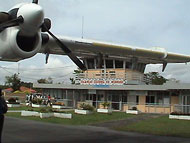
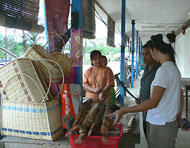
For the rest of us, flying is the best option. The 16 seater twin otter planes are fantastic! On normal days, when passengers are few, the plane will be laden with goods such as cooking oil, some electronic goods sent by family members living down in Miri, rice, tinned foods, home appliances, sacks of sugar and lots more.
|
The items get piled onto empty seats, along the aisle, at your feet, in the holding compartment and even in the nose of the plane. And just to make sure that the plane does not get overloaded, passengers are asked to stand on the weighing scales at the Miri airport checking counter.
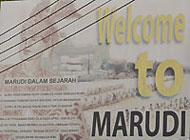
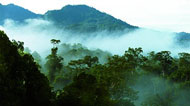
Just make sure you book your flight early enough. The flight across from Miri to Bario is a wondrous sight. The birds eye view of Sarawakâs jungles below, the Mulu National Park demarcations, the Murud Peaks, Batu Lawi and the small villages + longhouses dotted around in remote parts of the upper reaches of Baram â all can be seen from the tiny windows of the twin otter. Most flights to Bario stop over at Marudi. Normally, this is a routined stop for delivery of goods and also for parcel pick ups. For those children fortunate enough to have parents who can afford to pay for their flights, they fly home to Bario when school term ends.
|
To pursue further studies, children are sent for schooling in Marudi. Hence, this leads to migration of the kelabits. Most of the time, the longhouses are occupied by only the elderly folk and the very young.
There are several longhouses scattered just outside of town and there are few transport vehicles around. Most villagers make it back and forth their homes and town by foot. We managed to spend our nights in several villages as we make our way from one village to the other.
Larry, our licensed guide met us at the airport as the ground crew unloaded our bags onto the tarmac. He advised us that we should re confirm our return tickets at the ticketing counter before leaving the airport as the staff still uses the manual system of logging in their confirmations ie log book and a pen. There is a service charge of RM10 per person for reconfirmation of the return flight, payable in cash at the ticketing counter. Sometimes, when tourist season is low, a few of the homestay operators will make their way to the airport to greet any visitors in need of a place to stay. Nancy of NancyHarris Homestay, some 20minutes walk away from the airport , often drops in at airport to meet the flight in. If you havent already booked a place, dont be afraid to talk to those who approach you at the airport. Most likely, they're the owners of the homestays and not touts.
|
As we stepped out of the airport, we were met by several of Larryâs friends who had a couple of motorbikes of which we were to hop on and were taken to a homestay in town. There are a number of homestays and longhouses that can accommodate travelers and have been in operations for sometime now. For guests who are not able to converse in Malay, itâs best to stay at the homestays as the proprietors speak English.
The homestays provide lodging and fullboard meals quite often consisting of bario highland rice, wild boar dishes and jungle plants. All organic and most delicious! Its surprising how much of their food comes from the jungle surrounds. The danger now is that the logging is so intense in the upper Baram area, soon they may find difficulty in keeping to their traditions and livelihoods as many natives have suffered over the past years.
|
These homestays can also provide guests with licensed guides for day trips or even trips across the border into Kalimantan. There are several villages that travelers can stay at. We traveled to and stayed at PaâUkat, PaâUmor, PaâLungan as well as Bario town.
Bario town
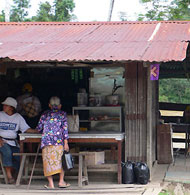
The town itself is a mere 20minutes walk from the airport. There is a small square where the main shops are with a sundry shop, a sort of handicraft shop, a little café and an internet station. The public phone is also located here. For those wanting to call home, this is it. This is also where callers from elsewhere can leave messages with whoever picks up the phone. The communication line here is almost flawless. The message will be passed on word-of-mouth along to even the furthest longhouse, situated hours walk away. Itâs impressive! So for example, if you want to contact a friend in PaâLungan longhouse , some 3hrs walk away, just leave a message with the person who picks up the phone and he/she will pass the message on to residents of that village or anyone heading that way from Bario town. Your friend will then have to walk 3hrs from PaâLungan to town to return your call.
Visitors can also buy items that are produced in the highlands here. The iodised salt from the salt spring is a good buy. Itâs not cheap but having seen the process, itâs worth it, plus itâs pure highland salt. Something that is difficult to get. Bario pineapple is juicy, sweet and totally organic. Itâs season is sometime in August and itâs the best pineapple I have ever tasted!
|
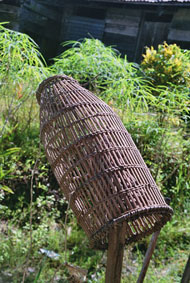
The other to look out for is the bario highland rice, Malaysiaâs premium quality organic rice. Itâs a little like the sticky rice that the Japanese and Taiwanese love to eat and it is definitely filling. This is what the farmers take out into the fields for their lunches. They usually wrap them in leaf to keep it moist, stuff it in their homemade rattan haversacks with a bit of wild boar meat or stir fried jungle plants. Itâs no wonder we still see octogenarians working on their plots of land from sun up till sun down. They live a frugal life with lots of fresh air and plain old exercise, they eat sparingly, sleep as the sun dips and wakes at the first crack of dawn. A boring life? Or a satisfying one?
The people in Bario are extremely friendly. Everywhere we went; they would come up and acknowledge us, shake our hands and usually stop a while for a chat. Just for a little walk up history lane, we visited an elderly couple living at the Ulung Palang Ditaq or now called Bued Main longhouse located on a hillock just outside of town. The original longhouse had been burnt down and the residents were relocated to the current site.
|
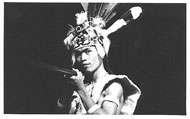
The couple was extremely happy to see us. The living room walls had a tapestry of the past pinned onto them. An old, tattered framed b&w photograph of 3 young men dressed in the traditional warrior wear caught my eye. âPakâ (uncle) pointed to a youngest lad in the photo as himself when he was in his teens. He recalled the day in 1945 when strange things fell out of the sky and brought them Tuan Mayur Harrison. The kelabit people regarded Tom Harrisson as their friend, family member and their advisor. The kelabits surprisingly welcomed Harrisson, Sanderson and Carter into their village readily. The ulu people disliked the Japanese and were eager to liberate the jungles of them. During my readings and research on this article, I came across a list of local natives who had helped the SEMUT operations and given their lives for the course. A name, Balang Ribuh from Long Napir Village was reported to have been eaten by Japanese! The stories of the Japanese soldiers must have been so dramatized by the villagers that the eventual feelings towards them must have sealed their fate in the ulu baram area. âPakâ was only a young lad in 1945 but he remembered the fervour and excitement of helping the white people defeat the enemy. After the war, Tom stayed on in Bario and the penghulu Lawai Besara (chieftain) honoured him with a local wife, Bongan.
|
However, he later found out that the wife, accorded to him was of no ranking and demanded that she be replaced by another with an aristocratic lineage. He found such a wife in Sigang, who also became his tutor into the ways of the kelabit of which Tom eventually documented and published copious papers on the cultures and traditions of the ulu people.Â
During Pakâs young days, the missionaries had not arrived in the bario highlands. It was only after the war that Reverend Mr & Mrs Southwell made a visit to Bario . The couple was in Borneo way before the war and they found the Borneo Evangelical Mission. However, as the war progressed they were incarcerated and spent most of their time in the Batu Lintang internment camp, just on the outskirts of Kuching. Upon liberation, they set out to continue their work in the kelabit uplands. Today, most residents have converted to Christianity. To Tomâs disappointment, the peopleâs taking to the religion meant that excessive drinking and merrymaking had all but disappeared, of which he was very fond of. The arrival of the missionaries completely changed life on the Plain of Bah.
more on Bario and the surroundings ...
Accommodation and Holiday Packages to Miri, Bintulu, Sibu, Labuan, Mulu , Bario Highlands and Surroundings
Other Parts of Sarawak
Kuching, Semengoh Orangutan Centre and Surroundings ~ | 3 Days 2 Nights Kuching Holiday Package | 4 Days 3 Nights Kuching Holiday Package | Kayakking in Kuching | Kayakking with Dolphins | Borneo Highlands Kayaking and Semengoh Orang Utan Rehabilitation Centre Adventure Trip | 3 Days 2 Nights River Cruise & Jungle Hike | 3 Days 2 Nights Beach & Jungle | 3 Days 2 Nights Jungle Homestay Package |
Kuching and Outskirts ~ 4 Days 3 Nights Kuching & Damai Beach Holiday Package | 3 Days 2 Nights Kuching City & Bako National Park Package | 4 Days 3 Nights Kuching & Batang Ai Longhouse Safari Package | 5 Days 4 Nights Kuching, Batang Ai and Bako National Park Holiday Package | 5 Days 4 Nights Kuching City & Iban Longhouse Back to Nature Package | Nanga Sumpa Iban Tribal Longhouse Stay |
Peninsula Malaysia Hills & Mountains |
| Cameron Highlands | Bukit Chini | Fraser's Hill | Maxwell Hill | Bukit Jerai | Gunung Tahan | Penang Hill | |
Sabah and Sarawak, Borneo Highlands & Mountains |
 More on Bario...
 Getting There and Away
 Best Time to Go
 Bario accommodation and packages...