Parrotfish
These colourful fishes are common in our reefs. The Parrotfish is so named because of its vibrant colour, its flapping fin motion and its large front teeth which are fused to form a 'chisel-like structure' like a parrot's beak. The beak is ideal for scraping algae and other living material from the rocky surfaces. At the same time chunks of coral rock is chiselled off the rock surfaces and ingested. To extract the remaining algae within these chunks of rock, the morsels of rocky corals are ground down by sets of teeth in the throat. The organic material is digested and the waste product is excreted in the form of coral sand. During its life, a Parrotfish can produce hundreds of pounds of coral sand, which contributes to the white sandy beaches found on our beautiful tropical islands. It may seem a rather primitive and inefficient way to earn a living, but according to John E. Randall who has researched extensively into Parrotfish behaviour, this method makes the Parrotfish a much more superior competitor to other reef grazers.
Parrotfishes are hermaphroditic fishes, that is, both the male and female sex organs are found in individuals. They are protogynous hermaphrodites where they start off in life as females where they undergo a series of physiological changes to
the reproductive organs that are triggered by social signals. Over their lifecycle, the fish may undergo five to six colour pattern stages. In some species, the terminal male also called the 'supermale' has a distinct colour differentiation from the rest of the herd. Supermales are the most vibrant coloured and largest of all the individuals in the herd. They are usually green with bright markings on the head. Parrotfishes can sometimes be seen feeding in groups. The Bumphead Parrotfishes are commonly seen in large herds, grazing on the corals.
At night, the Parrotfish secretes a transparent mucus cocoon which envelopes the entire body except for a little hole at the mouth area and another on the tailend. These openings are to allow water to circulate the cocoon, bringing in oxygen. The parrotfishes can sleep very soundly and this protection, although we may think that it is only a flimsy film of mucus, is invaluable to them. The cocoon is believed to block the olfactory cues from predators such as eels.
These strangely shaped fishes are the largest of the parrotfishes and can grow to a massive 50kg in weight. They travel in small groups of 5 to 15 individuals, sometimes can be heard crunching on corals some distance away. Often when observing parrotfishes, they are seen excreting a stream of fine sand. The hard bits of coral swallowed together with algae, is further processed and pulverised to extract the remaining organic material and then excreted as waste product. So as you sit on the beach, running sand through your fingers…think…the fine white sand could be a product contributed by parrotfishes. Without them, we may not have such beautiful islands.
The primary phases of the Parrotfish is difficult identify. These fishes go through a number of colour changes and juveniles' colours may differ greatly from the adults'. The adults have most distinct differences. The 'initial' phase differs from the 'terminal' phase. The terminal or supermales are much larger than the initial individuals and definitely more vibrant in colour.
The supermales have pole position in the herd and are the champion spawners. It has been noted that the larger of any fish species are capable of spawning in huge quantities as compared with their younger and smaller counterparts.
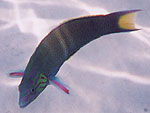
This fish is common and can be found throughout the Indo-Pacific and even in Hawaii. Marine aquarium enthusiasts have them on the list of favourite aquarium fishes. The adult males are green with bright orange spattered on its cheeks with varying shades. The bullethead has green teeth whereas the females have pink mouths. The juveniles are usually draped in dull rust colour.
This Parrotfish species live in pairs and can be found often chomping on corals nearby. The Bicolour Parrotfish has a pointed snout with a sickle-shaped caudal fin. The male is spattered with colours of fuchsia, green and blue while the female is a little drabber in appearance. She is coloured brown with lots of dark spots on the lower part of the body. Travelling in pairs, the female's presence falls like the shadow of its exuberant mate.
Wrasses
One of the largest families on coral reefs - with the exception of the Napolean Wrasse, they are small elongated fishes with a swimming style similar to parrotfishes, butterflyfishes and other distinct reef fishes where pectoral fins are used to steer, hover, reverse and manoeuvre instead of provide them with speed.
Wrasses have small, sharp and protruding teeth which is used to scoop up small crabs, snails, worms, shrimps, eggs and other invertebrates during their grazing hours on the bottom. Their pharyngeal jaws allow them to crush hard shells to reach the soft, succulent meat within the protective cover. Some species of Wrasses such as the cleaner Wrasses have specialised tasks. They pick parasites embedded under the skin of larger fishes by making precise, surgical incisions in the hosts' flesh with their tweezerlike teeth. At the same time they receive a hearty meal from this delicately conducted task. They also clean the larger fishes' teeth of any morsels of food wedged in between their teeth…sort of a tooth-picking service.
Many Wrasses can operate one eye independently of the other. Which means that one eye could be watching for prey and the other watches direction it is going. Unlike the butterflyfish which has good binocular vision due to the eyes set well in front of the head, the wrasse's eyes are set well back from their snouts which means that its depth perception is impaired.
When night falls, the Wrasse must find a good hiding place as, like the Parrotfish, it is also a sound sleeper. Some species bury themselves in sand, using their well adapted snouts to drill into the soft substrate. They also hide in the sand whenever there is danger, turning their bodies at right angles to the sand and diving vertically in. whence it hits the sand, it repositions itself so that the body is parallel to the substrate. It remains still in this position just close enough to the surface so that the gills can function. Sometimes an eye is exposed so that they can check on the surrounding before stirring from its hiding place.
Wrasses are not comfortable with muted light conditions. When the skies cloud over, they stop activity and disappear or head for cover in the sand for a little nap until the skies clear. They even rise later or retire earlier if the skies are grey.
Wrasses like parrotfishes are also hermaphrodites. Most Wrasses are protogynous, that is they begin life as females and mature into females. However, the dominant individual in a group of Wrasses is always a male and he controls his harem of females. He is highly aggressive in controlling his females and even among the females there is also a dominance hierarchy of their own. If the dominant male dies or is removed, the dominant female begins to metamorphosise into a male to take over his place. Like in the cleaner Wrasses, the change is quick and within one to two hours, she already portrays the male aggressive behaviour toward other females and takes on the task of patrolling the territory. It takes the reproductive organs a little longer to metamorphosise, about 4 days. When this change has completed, he will be ready for spawning and male courtship. If there are two rival females of almost equal standing in hierarchy within a harem, there may be a tussle for the dominant male role. This may result in a split in the former harem as the two dominant females change their sex to take over the existing harems.
These tiny Wrasses are important to the reef system. Their main task is to maintain the health of the fish community and also get fed in the process. Juvenile Wrasses also take on this role of cleaning larger fishes temporarily until they grow too large for the job but for the cleaner Wrasses, this is their fulltime occupation.
They pick parasites embedded under the skin of larger fishes by making precise, surgical incisions in the hosts' flesh with their tweezerlike teeth. At the same time they receive a hearty meal from this delicately conducted task. The parasites often found feeding on their hosts are tiny crustaceans known as copepods. The Cleaner Wrasses 'nit pick' their way round the body, into the mouth and even the gill chambers. They also clean the larger fishes' teeth of any morsels of food wedged in between their teeth…sort of a toothpicking service.
They often establish relatively permanent cleaning stations especially under rock boulders. each station would either have an individual Cleaner Wrasse or in pairs. The Cleaner Wrasse has a bluish tinted body with black stripes running the length of the body. They move in a distinct, pronounced manner, using its pectoral fin to rock its rear portion of its body up and down…a way of advertising its trade. Sometimes this cleaning service is in such demand that there may be a queue in front of the stations. The fishes of all sorts will wait patiently for their turn. The Cleaner Wrasses even gets to clean the sharks and rays that happen to be dropping in!
The Napoleon or Humphead Wrasse is probably the most wary fish I have ever had a chance to get near. Well usually, the closest a diver would be able to approach a Napoleon would be at least 3m..unless, off course if they have been tamed. These shy creatures are huge, sometimes casting a daunting shadow from above and watches every movement in the water with great curiosity or suspicion. An adult individual can weigh 190kg and is usually seen wandering own its own in the outer reef slopes, hanging around in clear waters between the ranges of 10 and 100m deep.
These great creatures look as ancient as the sea, and survive on a delicious combination of nutrition from molluscs, fishes, sea urchins, crown-of-thorns starfish, crustaceans and other invertebrates. For such a bulk to carry around and maintain, one cannot be too fussy about the food variety.
A much smaller cousin of the Napoleon, this colourful Wrasse has a stocky body with a large head and a blunt profile. It's dorsal, caudal and anal fins are speckled with red spots and the ventral fins are dipped in scarlet red. Like the other Wrasses, the Redbreasted Maori Wrasse feeds on invertebrates like worms, crustaceans and shrimps and the occasional healthy serving of eggs.
To the untrained eye, the Moon Wrasse may resemble the Bicolour Parrotfish. To differentiate the two, there are a few points to look out for. The Moon Wrasse has a sturdy body with a rounded head and a short snout. The head is bluish-green with pinkish stripes running longitudinally right down to the gill cover (the operculum). The caudal fin in adults is crescent shaped, yellow in the centre with pink streaks running down the lobes. The Moon Wrasse is much smaller than the Bicolour Parrotfish, which can grow to 80cm in length.
This fish has an elongated snout, which is adapted for rummaging for food amongst coral rubble, in holes and within crevices. The Bird Wrasse feeds on molluscs, brittle stars, tiny crabs, shrimps and juvenile fishes. A research done in the Red Sea describes a common relationship between the Bird Wrasse and the Yellow Goatfish (Parupeneus chryseredros). The Wrasse uses its elongated snout to probe for food in the sand and gravel, and in nooks and crannies within rocks. The goatfish in return lends its sensitive sensory system to home in on the prey. They work in tandem, sometimes the Wrasse leads and sometimes the goatfish leads. Their teamwork seems to produce good hunting for both parties.
Young Bird Wrasses are white with a pair of black stripes running the length of the body whereas females and young males are black on the rear end but white on the front half, dotted heavily with black spots. The supermale or terminal male is bluish - green in colour. These Wrasses wander in the outer reefs to a depth of 30m but prefer coral rich areas where food supply is easy to source for.
Triggerfish
There are 18 different Triggerfish species found in South-East Asia. The Triggerfish is so named because of its hinged, strong dorsal spines. These spines are used as a defensive tool. On normal occasions, the dorsal spines lie flat against the body in a groove but when threatened, the spines cock up at right angles to the body. These triggers are also useful when the fish retires for the night. Triggerfishes squeeze into tight crevices and wedge themselves in by erecting their dorsal spines; the first spine is locked in place by the second spine. This move in turn pins them in their safe cubicle …they are almost impossible to extract once they lock themselves in position. The bright full moon can affect the behaviour of diurnal (daytime) fishes like Triggerfishes. When the moonlight is bright enough, it has been observed that some Triggerfishes wake up to look for midnight snacks.
|
Balistiform
Triggerfishes like the butterflyfishes, filefishes, and trumpetfishes follow a swimming style called the "balistiform". They move by undulating their dorsal and anal fins which creates a backward thrust against the water and in return the force propels them forward. This balistiform method allows the fish to manage complex manoeuvres such as backing up, hovering and sharp turns. |
Triggerfishes are some of the noisiest fishes on the reef. Their powerful teeth are used to drill into the shells of molluscs creating a dull drone in the process. And several kinds of Triggerfishes beat their pectoral fins just behind the gill opening…where the gas bladder is situated, making a tattoo that can resonate loudly through the waters.
Triggerfishes are very attentive to their cluster of eggs. In preparation for the egg laying process, fanning the area with their dorsal and caudal fins creates a depression in the sand. They turn to their sides to conduct this task, alternately flapping the fins until they are satisfied with the condition of the nest. Then the eggs are laid and guarded by one or both parents who aggressively drive away egg marauders such as Wrasses. Triggerfishes have been known to attack intruders much larger than themselves, even divers and snorkellers who have unsuspectingly stumbled into their nesting sites!
In Malaysia, the Chinese name the Triggerfish, 'Sea Chicken'. It is so named because its meat is white and its texture somewhat resembles that of the chicken. I have seen fisherman skinning the Triggerfish. The skin fits like a leathery glove. Therefore to remove the skin, the fisherman slits the skin from the caudal fin and pulls off the entire skin from the body.
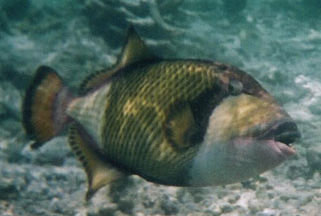 Sometimes this large Triggerfish is seen hard at work on sandy bottoms, making depressions in the sand by fanning the area with its pectoral and dorsal fins, and cleaning the area of coral rubble by picking them up with its teeth and chucking them further away from this selected area. In no circumstances should divers or snorkellers approach the fish. It is preparing the area for its nest. The female would lay its eggs in this depression and guard them vigilantly. During the nesting season, the female may become extremely aggressive and have been noted to attack divers. So if you do see the Triggerfish acting strangely…keep well away, they can leave you with a pretty nasty experience!
This Triggerfish as like others are shaped like a rugby ball with a small mouth and powerful teeth to crunch on hard shells. The Orange-lined Triggerfish feed on algae, coral, sea-urchins, crabs, sometimes Crown-of-Thorn starfishes, worms and sponges. Triggerfishes blow jets of water under the sea urchins, eventually toppling the urchins over. Once the sea urchins are turned upside down, the Triggerfish can easily feast on the creamy, soft body of its prey.
Relatively difficult to find, the Yellow-margin Triggerfish is atypical of the Triggerfish species. It has two rows on the upper jaw and only one lower row.
Clown Triggerfish are easy to spot. It is usually seen patrolling its territory on its own or sometimes in pairs in clear waters on the steeper slopes of the reef between 5 and 75m. As seen in the sketch below, the loud white blotches against the black background has always been seen as part of an evolutionary process that may be advantageous to the fish. It could also be possible now, based on another school of thought, that the garish pattern and coloration have no use at all to the fish but exist, as this does not confer any disadvantage to the fish.
The Picasso Triggerfish is so named because of the fine artwork painted on its body. It lives on shallow waters of about 5m in depth, moving about on flat coral reefs and a lagoon, searching on the sandy seabed where it excavates tiny invertebrates such as crabs, shrimps and sometimes searches for eggs and juvenile fishes.
Triggerfishes are sometimes seen at cleaning stations, posing with their heads downward whilst waiting for a clean. (Read section on Cleaner Wrasse)
Illustrations provided by Dennis Ho: Underwater photography by Moti Uttam
Corals & Fishes in Malaysia
| Corals - Hard & Soft Corals | Eels | Sharks | Rays | Octopus | Squids and Cuttlefish | Nautilus | Nudibranchs | Clams | Starfish | Brittlestars | Featherstars | Sea Urchins | Sea Cucumbers | Worms | Sponges | Jellyfish | Damselfish | Butterflyfish | Angelfish | Surgeonfish | Parrotfish | Wrasse | Triggerfish | Batfish | Trumpetfish | Squirrelfish | Catfish | Grouper | Athias | Sweetlips | Fusiliers | Puffers | Filefish | Trevally | Snappers | Scorpionfish | Cardinalfish | Goby | Barracuda | Rainbow Runner | Pompano | Bream | Goatfish |