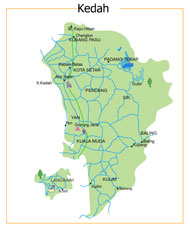
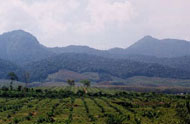
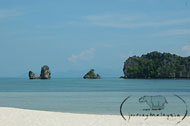
Highlands - Gunung Jerai | Cities - Alor Setar | Islands - Langkawi | Pulau Payar | Historical Sites - Lembah Bujang | Rainforest - Ulu Muda Forest Reserve | Lakes - Pedu Lake |
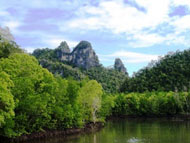
The two northern states of Kedah and Perlis show traces of Malay history dating back before the Melaka Sultanate. This is the "rice-bank" of Malaysia and visitors are greeted with stretches of green 'padi'/rice plants gently swaying with the breeze which turn to a golden brown when the padi is ready for harvesting. The gentle plains merge with undulating hills and valleys, rising to the majestic limestone mountains in the north and east. The legendary Langkawi Archipelago steeped in history and myth, a haven for tourists, lies offshore. The history of both Kedah and Perlis has been intrinsically influenced by Thailand.
Early History
(Historians date early international sea trading from early logs of sea captains, traders and from mappings, ledgers or any fragment of documentation collected).
In the 4th Century, the Indian and Arab merchants discovered vast trading opportunities using sea routes as opposed to the caravan routes. They also knew only too well that jungle products were as good as gold to their rich customers who could afford all the riches the rainforest jungles could offer. With much trouble of war and tribal scuffle on land, the merchants eventually took to sea.
Jungle products such as the aromatic gahru wood, camphor and animal products like kingfisher feathers and rhinoceros horns were very much in demand. The merchants knew nothing of the particularities of the jungle or its secrets. Hence, they employed locals or dealt with middlemen. Malay middlemen themselves rarely ventured beyond the fringes of the jungle, for they were not familiar with the interior - the belief of powerful spirits and demons in the jungle kept them from straying too far from the coasts and riverbanks They in turn employed the forest dwellers, generally forefathers of indigenous people or the Orang Asli of today.
The forest dwellers knew intimately every stone, plant and inch of their territories. They knew that when the gahru tree showed signs of disease infection and when the bark peeled off whilst the leaves wilted away, then it was time to harvest the valuable heart of the tree. They also knew that precious camphor grains were found in the trunk of a tree where only chipping of its bark revealed distinct fragrances.
The value of certain jungle products was also determined by its rarity and the secrecy that shrouded their collection. The beliefs and myths were so ingrained in these collectors that some even adopted a special language and observed strict diets while gathering certain jungle products.
These produce were transported to central collection points and then were later funnelled to port-of-calls where trading ships were docked and waiting for their shipments. One of such popular port-of-calls was Kedah.
In the early centuries of great seafarers (7th to 13th century), Srivijaya a great maritime kingdom ruled trading centres along the Melaka Straits. Although historians have often disputed on the location of Srivijaya, many believe it to be sited close to Palembang in Sumatra. The ruler of Srivijaya realised Kedah's potential as a great northern entrepot and with that, Srivijaya granted Kedah vassal status. The possibilities were endless for the Srivijaya kingdom to maintain a 'state' in northern Malay peninsular and the thought of Kedah falling into the hands of the formidable Siamese were daunting. Moreover, Indian traders preferred Kedah to many of the other ports in the straits and business was brisk. Merchants preferred trading in Kedah because of the honesty of local traders, safety of the port and the variety of products that were available for export. These Indian traders also contributed to the community by sharing their religion. They built temples along the coastal area and disseminated Indian folklore, tales and dance of which still strongly flavours the local folklore, culture and even language. The Buddhists came by later and built Buddhist temples alongside the Hindu shrines and temples.
By the 11th century, Srivijaya was losing its hold on the straits and Kedah seized this opportunity to make a bid for independence. From historical data, it seemed that in 1068, Kedah's ruler may have rebelled and that Srivijaya then called for Chola's(a Southern Indian kingdom) assistance to quell the rebellion. Despite efforts made to maintain hold, Kedah seemed to slowly slip away from the stronghold of the struggling kingdom. By the 13th century, Kedah was sending its own ships to Southern India on trading missions. Finally, Kedah was coming into its own.
Thai Influence in Kedah
During the 13th century, leaders from a Southern state of Siam at Phetburi moved downwards to the Malay peninsular and took up residence in Malay speaking areas. The Siamese cleared forests and established ricefields in these states and claimed them under Siam control. Kedah was one of the several lands taken under the 'wing' of the Siamese. However the Siamese appointed local Malays to rule over their lands, but under the loose control of the Phetburi royal family. With this, the Malay rulers had some autonomy in which to rule their states but were coerced to supply food, army and send tributes to their overlords.
Yet the Indian traders continued to travel to Kedah, happy to trade in spices that were otherwise under tight Dutch control in the 1600's. Kedah, with access to the Pepper Island (Pulau Lada) of Langkawi was favoured by the Indians.
Domestic disputes
However, by early 17th century, internal conflicts between rulers and rival princes began to shake the stability of Kedah. The situation was made worse by interference of the Thai kingdom. Soon, merchants began taking their trade to Melaka and elsewhere. The entrepot fell into disuse and people of Kedah turned to agriculture to support the state. This economic status has remained till this day and now Kedah maintains as the 'Rice bowl' of the country.
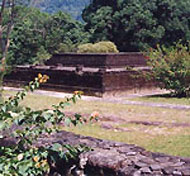
Today, there remain some evidence of Kedah's past- the Thai temples are still around and Lembah Bujang holds one of Peninsular Malaysia's largest archaeological sites.
Accommodation and Holiday Packages to Kedah : Alor Setar , Langkawi and Surroundings
States in Peninsular Malaysia |
| Perlis | Kedah | Perak | Penang | Selangor | Kuala Lumpur (Wilayah Persekutuan/Federal Territory) | Negri Sembilan | Melaka | Johor | Pahang | Terengganu | Kelantan | |
States in Borneo |
 Places of Interest in Kedah
 Accommodation & Packages to Kedah
 States in Malaysia