Town Hall
This is one of Ipoh's architectural wonders that boasts of neo-classical architecture, a design so popular in the early 1900s. The Town Hall exhibits a great marriage between renaissance and roman architectural features. Construction began in 1913, and was finally completed in 1917. Throughout the century, the Town Hall have seen many people from various backgrounds and expertise utilising, and walking up and down, its hallways. This building has also served as a Post Office, and was once the District Police headquarters in 1948.
The Padang
Padang is the Malay word for 'field', and this is exactly what it is - which is also exactly where pale British males marched into the field with their starched white cricket ensemble to hit a wicket or two, running every now and then out of the field to catch several gulps of the most refreshingly cool beer. At other times, the same men could also be seen kicking around this Padang attempting to score a few goals in a game of soccer.
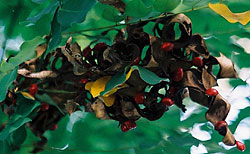
Once plentiful , now found only scattered in old gardens and botanical gardens - remember these found as fillers for 'five stones' ? |
Ipoh has left the Padang unscathed, together with the beautiful casuarina trees that has been encircling the field for almost a century now. Much time has passed, people had come and gone, and old generations have made way for the new. But, Ipoh realises that this does not necessarily mean that traditions need be forgotten. Today, we still see people running about the grounds; whitemen they are not, but happy locals spending quality time with their family members.
Royal Ipoh Club
And what's the use of a Padang without a Club? Planters, tin miners and administrators patronised this black and white Tudor style clubhouse. While the athletic ones trampled about under the scorching hot sun, the more stationary ones worked their lazy muscles trying hard to keep their cigars in between their fingers while downing their whisky.
FMS Bar and Restaurant
FMS stands for "Federated Malay States", which was basically created to lump all the Malay states which fall under British administration under one union. And Perak happened to be one of them. Although the building was built at the turn of the century, it was only in 1906 that they proclaimed it to be bar and restaurant. Both bar and restaurant (together with its antique décor) have managed to survive the ravages of time, and is believed to be Malaysia's oldest functioning Bar!!
Planters and merchants used to frequent the Bar. Located just opposite the Padang, our jovial sportsmen would quite happily mosey along to the FMS Bar after their match, or maybe for some, after their first round of drinks at the Royal Ipoh Club.
The FMS Bar and Restaurant remains to be quite popular; however, time has altered the culinary preferences here. This would certainly be quite an experience, and not at all out of character; even if you take into account that you're inhaling the savoury aroma of your Szechuan Prawns while slurping in your Belacan Kangkong, right under the shelter of this exceptionaly British institution.
Birch Memorial, The Clock Tower
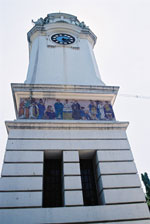 |
Secluded and hidden it is. And for good reason of course. JWW Birch was an unpopular character who was appointed as Perak's First British Resident. He was arrogant and showed no sensitivity towards local customs, religion and nuances. He did not think much of the Malays. Likewise the feeling, too, was mutual amongst the Malays, especially the royalty. It wasn't surprising at all that he was eventually assassinated by the Malays, headed by a chieftain called Dato' Sago. Call it mere coincidence or downright contemptuous, Birch's memorial is strategically located directly opposite a mosque and cramped behind Jalan Dato' Sagor. Even after his death, he is still surrounded by scorn and derision from the Malays.
For whatever Birch was to the Malays, the British made him a hero. On all four sides of the monument, colourful murals depicting various 18th Century professions of men decorate it. There, they also erected a bronze bust of their Mr. Birch. And so, the Clock Tower is quite a fine monument; even now, despite the absence of the presence of the bronze sculpture of Birch (which someone had so nicely removed). Isn't this just telling! Nobody wanted him and they still don't want him here. Oh, poor Mr. Birch.
Ipoh Railway Station
Some call it the Taj Mahal of Ipoh! No doubt that it has nothing to do with employing South Indian labourers in its construction, but truly because of its majestical neo-classical architecture. Its magnificent domes and almost perfect arches are reminiscent of those found in a Moorish palace, a design much favoured by AB Hubback, the same man who designed the Train Station in Kuala Lumpur.
Built in the height of the tin mining industry, the station was an important feature for the colonials in transporting Kinta Valley's valuable mineral. Regrettably today, the station appears to be suffering a grim and humbling existence. The ground floor is now segmented, giving space to house massage parlours. Wires crisscross the section and signs bearing the word "URUT" spread wide above the crude crass cubicles. Every night a market sprouts within the compounds of the Train Station. Loud blaring music and the inconsiderate throttling sounds of motorbikes choke the now long gone serenity. And the landscaping….? "What about the landscape?", these people would probably indignantly throw back the question at you.
 |
AB Hubback would weep to witness this inconsiderate demeanour. It is hard to imagine that this was once a place so important, a mark of architectural accomplishment and commercial supremacy. But then again, these are hardly people who would care to appreciate its architecture with awe and admiration, nor respect its historical significance to shaping Ipoh to what it is today. It makes no sense to them to have anything more than just a commercial attachment to the station. Trapped in their single self-seeking objective to make money, conserving this historical building bears no relevance at all to their prosperity or survival. For what is pride for one's own history if there is so much more to be gained now today for the material wealth of tomorrow?
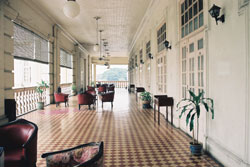
Above the train station, on the second and third floors resides the Station Hotel, also known as The Majestic Hotel. Take the ancient lift up to the main lobby, and it will take you back in time. In the early 1900s, the hotel boasted off 'first class accommodation' and 'excellent cuisine'. A 200m long verandah runs the length of the building. During those days, planters planted themselves in rattan chairs, the smoke from their pipes whiffed away in clumps of tiny clouds trying to ascend all the way up to the high ceilings. Ceiling fans swirled rhythmically all day long to cool the consistently sweating masters. A cosy bar satisfied the liquid needs of its thirsty patrons..
But today the hotel is not looking quite all that chirpy and healthy. It bears a tired face and a physique that is rather run down. The walls suffer a degrading presence, stained by markings in the colour of soot. Its white paint is peeling off in flakes. Unlike the verandahs, the rooms are not crowned with the same high ceilings. Much of their ceiling space is seized to accommodate ventilation ducts and air-conditioning piping, sloppily hidden by cheap gypsum ceiling. And it is because of this too that when you enter the rooms, you are greeted by the smell of damp and must. Dream not of diving into a huge plush comfortable Victorian style bed, but instead pretend to be contented with the three beds that consume most of the space of the shoebox shaped room. Perfect for families who want to save on hotel rates. Disappointing for those dreaming of reliving the luxury of the "first class accommodation" of the early 1900s.
But this is the 21st century, cast away your dreamy imaginations of colonial splendour. Today the Hotel serves a better purpose (?) by providing clean rooms at attractively competitive rates. You can start your day with a hearty breakfast consisting of toast, fried eggs and sausages (the cost of which is already covered in the room rates). One huge plus point which plants a smile on your face is the contagious smiles of the hotel staff who are also ever so helpful.
So, it is not all that bad and it is quite a relief to see much of the façade still remains and fittings still in tact. The banisters and wooden stairs stand firm and proud in their original places, and the slow iron elevator makes the journey up to the third floor charmingly pleasant. So, when you storm along the verandah, stomping on those cool and carefully laid tiles, try and show a little more care and look down. For these are the same tiles on which, a long time ago, haughty Victorian ladies carefully and gracefully walked upon. Look up, and you will see that the fans are there still, together with the ornate iron engravings proudly wrapping their bases. Look beyond the verandah and out into the far horizons, you will see Ipoh and its rolling hills staring back at you with the same beseeching scrutiny they gave the colonials a hundred years ago.
Accommodation & Packages to Perak ~ Ipoh, Gopeng, Taiping, Lumut , Pulau Pangkor, Maxwell Hill , Kuala Kangsar, Belum and Surroundings
Malaysia Cities , Towns & Villages
Peninsula Malaysia Cities , Towns & Villages |
|
Kedah |
| Alor Setar | |
Terengganu |
| Chukai | Dungun | Kemaman | Kijal | Kuala Terengganu | Paka | |
Perak |
| Ipoh | Kuala Kangsar | Lumut | Taiping | |
Selangor |
| Klang | Kuala Selangor | |
Kelantan |
| Kota Bahru | |
Federal Territory |
| Kuala Lumpur | |
Johor |
| Mersing | |
Negri Sembilan |
| Seremban | Kuala Pilah | Lukut | |
Pahang |
| Sungei Lembing | Kuala Lipis | Kuantan | |
Melaka |
| Melaka | |
Sabah and Sarawak Towns , Cities & Villages |
|
Sarawak |
| Kuching | Long Bedian | Long Lama | Long Terawan | Miri | Marudi | |
Sabah |
| Sandakan | Kota Kinabalu | Tawau | |
 Getting There and Away
 Best Time to Go
 Food in the city