Early Beginnings
Legend goes, a long time ago when men were chivalrous and jungles were lush, an Admiral and his trusted men sailed from Sumatera traversing the Straits of Malacca into the Golden Kersonese. They scaled up the broad blue waters of the Kinta River, following their instincts and the liquid path the river offered. There was plenty of fish from the river to feed upon, and the jungle dwellers entertained these seafaring men with their forest calls, their melodious twitterings and barblings. Alas, the expedition had to end for the sailors had then reached a point where their vessel could no longer venture and the river would no longer allow them to navigate.
It was also a magical time where genies spoke, the orang kayangans (fairy-like beings) roamed and foresightedness of sorcerers revered. And so it was told a genie commanded that the district be named Kulop Kinta. And long after the expedition, where villages opened and communities flourished, the Admiral decided to make this his home, and he then assumed the royal post of Dato' Panglima Kinta.
"The Town that Tin Built"
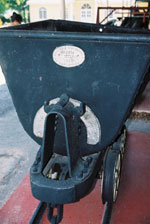
Tin was transported in these to the smelting plant |
It may very well be so, but curious enough Ipoh was never in the true sense a mining town.
It was marked in an English map, in 1880 as "Epu". And later in 1884, a French tin prospector described Ipoh as a Malay kampung. And not far from the truth it was. Ipoh was pioneered by the Malays who were attracted to the mining activities surrounding it. Back then, tin mining were very much in the hands of a Malay Chief, Dato' Panglima Kinta.
It was just its good fortune that Ipoh is located in the center of the tin mining area, the Kinta Valley. The lure of prosperity promised by prospecting tin was irresistible, tempting, almost seductive. And it was because of this that Ipoh saw a steady emigration of the Chinese. At first they came in small numbers, and by 1888 the Chinese population had swelled up to 38,000! From a mere frontier town, Ipoh became the center for tin collection and smelting.
All About Ipoh
The Orang Asli call it Upas, and use its sap to coat the tips of the darts of their blowpipes. Others call the tree Ipoh. And this was the name that the people had chosen to call the town. In those days, Ipoh trees were found everywhere, in abundance. And for this reason we should be alarmed if not ashamed, that there are only two of these trees left!! One is standing in front of the Ipoh Train Station, and the other can be found in Taman D.R. Seenivasagam.
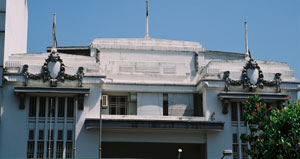 |
The Kinta River basically runs through the middle of the town. In 1892, a great fire gutted the East part of Ipoh. The town had to be rebuild, looking all new and grand, and rightfully so, it became to be known as "New Town". The reconstruction of the New Town also made way to deliberate town planning. And this explains why buildings file along roads that are set into systematic grids.
Another curious fact about Ipoh is that, although it was a rich town, it was not the original administrative centre of Perak. Even more curious, it was not the British, but the Japanese that provided the turning point for Ipoh. During their occupation of Malaya in 1941, the Japanese Imperial Army transferred all administrative concerns from Batu Gajah and Taiping to Ipoh. Funny enough, the British actually endorsed this arrangement when they returned to power, and continued to retain Ipoh as Perak's administrative centre.
Ipoh's Heritage
The happy thing about Ipoh is that it has retained much of the charm that enveloped it during its heyday. The buildings built from the money derived from tin (and amassed by the colonials) did everything to expose the identity of the nationality of the men who designed them. Big trees with wide canopy that line the suburban Ipoh roads provide glimpses of the British want for greenery and shade from the grueling tropical sun.
The Perak Museum
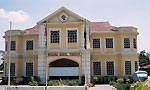 |
Let's begin our journey at a place which will reveal all you want to know about the history of (mostly) Ipoh. The Perak Museum was erected in 1926 by a rich and successful tin miner called Foo Choong Kit. Back then, he built it for his own private domain, and it was told that once forty people were counted to be living in this house. The house did not stay long with the family. In 1950 it was sold to the Perak Government which utilised these premises to house the administrative centre of its Department of Works. It was not until 1992 that this building finally graduated to become a museum.
Have a browse through the museum. You can begin your tour by learning about the early history of Perak. Here you will be introduced to the many characters that moulded the state. Get to know all the important who's who. Find out who Hugh Low was, and what Swettenham achieved, or whether Clarke made any difference in his policies. There are plenty of pictures of British administrators and rulers who played enormously significant role in the building of Perak and Malaya..
If you are interested in architecture and would like to tour the town later, there is a room which enlightens you with a pictorial guide of most of the important and beautiful colonial buildings in Perak. This may help you later to identify the various buildings in town.
The museum also displays other historical facets, and in particular tin mining and various other industrial and commercial activities that are of importance to Perak.
The museum opens all week from 9.30am-5pm.
St Michael's School
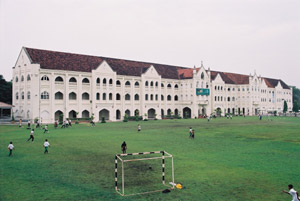 |
Perhaps the grandest and biggest of all the old colonial buildings in Ipoh is the St Michael's School. The St Michael's school was opened by a group of La Salle Brothers in 1912. Fitting to its name and the mission of its founders, St. Michael's was one of the more prestigious Christian missionary schools in Perak. And because appearance tells a lot about an institution, St Michael's architecture and façade are reminiscence of a true Christian masterpiece. The architecture is absolutely brilliant. You can't get enough from appreciating the carefully decorated gables and the lovely wide arched verandahs that run the entire length of the school. Right in front of it stretches the school green. If you're lucky, you may spot the school band marching up and down the field playing some musical score in their full regalia.
Even the Japanese army could not stay away from St Michael's. During the Japanese occupation, this army converted the school for its centre of administration for the state of Perak.
Accommodation & Packages to Perak ~ Ipoh, Gopeng, Taiping, Lumut , Pulau Pangkor, Maxwell Hill , Kuala Kangsar, Belum and Surroundings
Malaysia Cities , Towns & Villages
Peninsula Malaysia Cities , Towns & Villages |
|
Kedah |
| Alor Setar | |
Terengganu |
| Chukai | Dungun | Kemaman | Kijal | Kuala Terengganu | Paka | |
Perak |
| Ipoh | Kuala Kangsar | Lumut | Taiping | |
Selangor |
| Klang | Kuala Selangor | |
Kelantan |
| Kota Bahru | |
Federal Territory |
| Kuala Lumpur | |
Johor |
| Mersing | |
Negri Sembilan |
| Seremban | Kuala Pilah | Lukut | |
Pahang |
| Sungei Lembing | Kuala Lipis | |
Melaka |
| Melaka | |
Sabah and Sarawak Towns , Cities & Villages |
|
Sarawak |
| Kuching | Long Bedian | Long Lama | Long Terawan | Miri | Marudi | |
Sabah |
| Sandakan | Kota Kinabalu | Tawau | |
 Getting There and Away
 Best Time to Go
 Food in the city