 |
It’s funny how, as one grows older and one would imagine, wiser, there is an inclination to return to the woods. To a place all too familiar and all too much like home. Not necessary the home that was but the home that becomes.
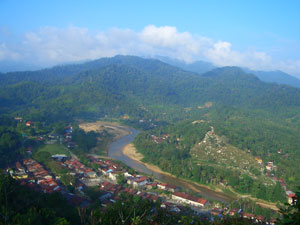
Few places thrill me as much as Sungai Lembing. It’s a time warp. Through the Looking Glass by Lewis Carroll goes like this, ‘Well, in OUR country,' said Alice, still panting a little, `you'd generally get to somewhere else--if you ran very fast for a long time, as we've been doing.' . `A slow sort of country!' said the Queen. `Now, HERE, you see, it takes all the running YOU can do, to keep in the same place. If you want to get somewhere else, you must run at least twice as fast as that!' `I'd rather not try, please!' said Alice. `I'm quite content to stay here--only I AM so hot and thirsty!'. To read, go to .
You see, that’s what happens in the city, we’re always running to get somewhere, something or someone. When at Sungai Lembing, the running will only ever get you to the same place so why run?
Sungai Lembing Then
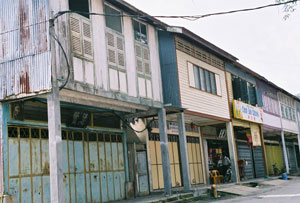 |
Sungai Lembing is an historic town. A village that started out as an outpost deep in the jungle of Pahang way before the British came on an exploratory search for tin. A few neglected tombstones a short distance away from dwellings mark the presence of immigrants from China who sailed in to the coast of Malaya during the later part of the Qing period in the late 1800’s and trudged through the jungle in search of riches. Immigrants moved in to pan for tin in richly laden Sungai Kenau and its tributaries in these early years. The area was so rich that after heavy downpours, tin got washed down out of the hills and jungle and into the rivers. Then, the British arrived and opened Malaya’s first deep shaft tin mine in 1905. The Industrial Revolution that occurred in Britain during the 18th and 19th century was sparked off by a spurt of inventions and technical breakthroughs. Raw commodities such as rubber and tin were in demand. The British scoured the lengths and breadths of their colonies for raw commodities. This continued way into the 20th Century and right up till 1957 when Malaya became Malaysia through independence from British rule. Despite the high cost of opening and maintaining a deep shaft mine, the Pahang Consolidated Company Limited, (PCCL), which was under British control, was signed to a 77year lease with the then Sultan of Pahang, to mine the area. The mine flourished and the company voraciously tunnelled deeper into the mountains in search of more tin to feed the revolution.
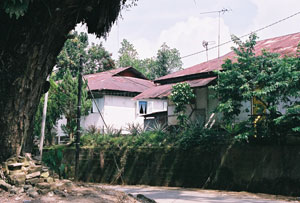 |
Soon, the sleepy hollow known as Sungai Lembing ballooned into a boisterous community of miners and families. By the 1950’s half of the 1,350 men working for PCCL toiled in the pits of the mountains. As they worked, the shafts snaked further across to the other ridges of the surrounding hills and punched deeper into the bowels of the earth. By the end of the mines’ tenure, the total tunnel length was 322km, with a depth of between 610m and 700m and there were at least 6 main entrances into these shafts from all round the hills. The 2 mines at Sungai Lembing were Myah Mine at 700m deep, and Tabeto Mine 488m
The miners that worked in the tunnels were mainly of Chinese race. Their typical day’s work started early in the morning. They crammed into a small open lift, and descended some 100s of feet to their work stations. In dark, damp conditions, the miners toiled laboriously for 6 hours and were rewarded with a wages of that commensurate with their job. In 1950, that was $40-$44 per day.
In the early years, the tunnels were manually dug into and later, dynamites were used to crack them open. Iron hammers were then used to dislodge rocks laden with tin from the walls of tunnels. These rocks were then loaded onto an iron cast trolley and lifted up to the surface via the same lift system the miners used. Once at the top, the trolleys are pushed onto tracks and then to the smelting and processing plant located at the bottom of the cliff. Once processed, the tin was then loaded onto flat bottom boats and were floated down the river to Kuantan.
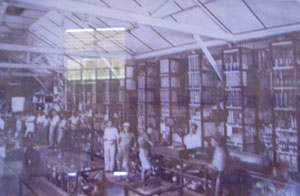 |
The British miners and managers lived a good life. PCCL made sure that their workers were given the best. They set up a huge convenience store that sold almost anything imported one could get their hands on in Malaya at the time. All duty free! Alcohol, imported tinned foods like baked beans & spam, cigarettes; you name it. The store was like a huge warehouse with shelves of goods reaching storeys high. And to think supermarket is a recent creation! The latest movies were shown at the theatre and night life was bustling. These privileges were also extended to the locals living within the 5 square miles of the valley. However, outsiders were not allowed to walk freely into town. A checkpoint was set up at the entrance into Sungai Lembing. PCCL was also responsible for the wellbeing of the town and provided townfolks with roads, electricity, schools and healthcare. (Unfortunately the beautiful wooden hospital located on a ledge up above the playing fields, was dismantled recently)
Cold weather in the early years brought out men in suits and women in cardigans. The surrounding jungles enveloped and cocooned sungai lembing, keeping it cool and agreeable with the British. The main transportation in those early years was by boat. In 1892, the Company commissioned a stern wheeler (steamer) which would eventually connect Sungei Lembing and Kuantan and hence, contact with the outside world. Unfortunately, due to recent logging in areas around and conversion of land to plantations, Sungai Kenau is no longer accessible by large boats. Silting has just about done it in for the river and flooding is not as rare as it used to be. A recent town flooding was in 2007.
Accommodation and Packages to Pahang ~ Janda Baik, Cameron Highlands, Taman Negara, Kenong Rimba Reserve, Fraser's Hill, Cherating, Pulau Tioman, Kuantan, Tasik Bera and Surroundings
Malaysia Cities , Towns & Villages
Peninsula Malaysia Cities , Towns & Villages |
|
Kedah |
| Alor Setar | |
Terengganu |
| Chukai | Dungun | Kemaman | Kijal | Kuala Terengganu | Paka | |
Perak |
| Ipoh | Kuala Kangsar | Lumut | Taiping | |
Selangor |
| Klang | Kuala Selangor | |
Kelantan |
| Kota Bahru | |
Federal Territory |
| Kuala Lumpur | |
Johor |
| Mersing | |
Negri Sembilan |
| Seremban | Kuala Pilah | Lukut | |
Pahang |
| Sungei Lembing | Kuala Lipis | |
Melaka |
| Melaka | |
Sabah and Sarawak Towns , Cities & Villages |
|
Sarawak |
| Kuching | Long Bedian | Long Lama | Long Terawan | Miri | Marudi | |
Sabah |
| Sandakan | Kota Kinabalu | Tawau | |
 Getting There and Away
 Best Time to Go