for photos of our trip to melaka in 2010 |
Munshi Abdullah and Sir Stamford Raffles
 |
At age 15, Abdullah bin Abdul Kadir watched as the British Forces marched into Melaka. The year was 1811.British troops were waiting for instructions to be sent off to Java. Stamford Raffles was appointed to be the Lieutenant Governor of Java(). Before embarking on a sea voyage to Java, Raffles stationed his army in Malacca where he planned the initial operations for advancement into Java.
Munshi (a title meaning 'tutor') Abdullah's encounter with Stamford Raffles was to have a very large impact on the boy's future. Employed as a scribe in his moderate but significant team of employees, Munshi Abdullah was given the opportunity to learn from a man who had an insatiable appetite for learning. Raffles wanted to know everything about the locals…their culture, their history, their myths and legends, their language, their arts and their creativity. He also was a budding naturalist and had a team of hunters and gatherers who collected animals and plant specimens, which were later preserved in jars or pressed into pages (respectively). Illustrations were collated into huge volumes of books.
Raffles collections grew to include rare manuscripts, books, written verses, sha-er and pantun. The people of Melaka then did not understand the value of such books and manuscripts. They readily sold them to the collector for cash. Such manuscripts were written in longhand and were originals - no copies were ever recorded. Other books that could not be bought, were borrowed and copyists had the task of duplicating them. Several copyists were employed for this task, and Munshi Abdullah was one of them. The exposure led him to write his autobiography in later years, called Hikayat Abdullah (The Story of Abdullah). For an excerpt of his views as a journalist and an observer, check out his writings on at
The Story of Malacca
(Malacca's story, we feel, is best told through the eyes of a historian and a tutor. In this article, we think it most apt to tell it as how Munshi Abdullah would have seen, heard and recorded which was later added in his autobiography, Hikayat Abdullah (The Story of Abdullah). We shall 'borrow' his voice and eyes in painting the picture of a once most important Asian port called Malacca.)
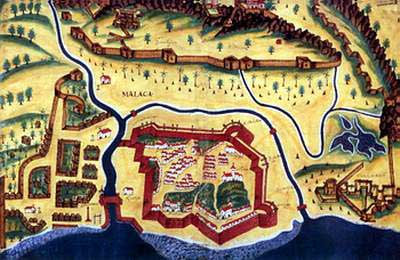
Melaka or Malacca or Malaqua (as it was known to the Europeans in the 1500's) began its humble existence as a fishing village and grew into the region's most important entrepot. For years, Malacca flourished under the watchful eyes of the Malay Sultans and the Chinese, until the struggle of power among the Europeans finally led to its slow and painful demise.
Its initial success under the governance of a Sumatran prince and his descendants was based on the model of an old entrepot called Srivijaya that ruled the straits for centuries before the 'discovery' of Malacca. There is still much debate amongst historians as to the exact period of this once great maritime empire which ruled the trading routes in the straits. The agreement lies somewhere between the 7th to the 13th century. But many believe that the nucleus of the kingdom may have been in Palembang. (Palembang, Sumatra - across the straits of Melaka in Indonesia)
I listen to the stories from the old men. They sit by the sea…as the sun sets and when the day's work is done, they recant stories told to them by their forefathers - of how great Malacca once was.
That, was centuries before I was born, back in the days of pirates, sea merchants from distant lands, rowdy Portuguese soldiers, sombre Dutch officers, inquisitive English administrators and before them, a renegade Prince called Parameswara. Here begins the story…
Parameswara
Parameswara - a young, hot blooded Palembang Prince had a reputation of being a bit of a rebel in the eyes of the Javanese 'overlords'. His wayward and antagonistic behaviour found him a number of admirers in the neighbouring islands who felt the same way as he did. They felt that their subservience to the Javanese should not be tolerated. The Javans, weary of this troublesome Prince moved quickly to quell his popularity. They invaded Palembang.
Parameswara fled to the island of Temasik with his loyal company of 30 orang laut (sea people). After eight days in Temasik, Parameswara killed the local chief and usurped as lord over the simple fisher folk of Temasik. Parameswara later renamed the old city, ' Singapore' after an incident where he spotted a strange beast which he took to be a lion (Singa).
 |
During the early days of maritime trading, a great number of the orang laut (sea people) earned their living through piracy. Parameswara and his followers spent 5 years at Temasik where they eked out a living growing rice, fishing and attacking passing ships. All was peaceful, until one day when the new, dynamic and powerful kingdom of Ayudhya in Thailand sent a force down to extricate Parameswara from his self proclaimed throne.
Once again, Parameswara and his followers fled and this time they headed up into Malaya eventually settling down in Bertam. Life was tranquil and the company of men resumed their business of hunting and growing rice. One day, as he was off hunting with his men not too far from the village, he encountered a strange scene. While resting under a Melaka tree not too far away form the river, he watched as his pack of dogs cornered a mousedeer. Instead of throwing itself into the river, to his amazement - the terrified chevrotain turned around and attacked the dogs. The befuddled dogs lost their footing and they, in turn… ended up in the river!
He was astounded by the will of the mousedeer to fight for its life and immediately knew that the hill of which he was standing on at the time would be his future. The area was named Malacca after a tree that shaded Parameswara during the incident of the mousedeer and the dogs.
When Malacca was established in the 1400's, there were already 2 entrepots of importance in the Straits - both guarding the sea route along the Sumatran coasts. Parameswara consciously selected his site with great care. After a time of searching, he finally found an ideal harbour. He chose a sheltered harbour, free from mangrove swamps close to the Melaka Hill. He knew that this harbour was positioned at the convergence of the sea lanes from India and China and was sufficiently deep to allow the large vessels to anchor in the bay to wait out the monsoons. Moreover, the Melaka river had a pleasant climate and ample supply of fresh water. However, the deciding factor was that the area had a vantage point. It had a naturally defensible position.
Parameswara was a smart man. He watched as traders from India, Arab and China came and went. He realised that he would have to convince the fishermen and village people to clear trees and plant crops like sago, banana, jackfruit and sugarcane; and trade in jungle products. He knew that these produce could be more profitable than piracy and with that, he could abolish piracy and make safe the passageway for trading ships. With a guarantee of pirate safe passageways, and a supply of jungle products and gold from the interior, merchants began to take notice of the new deep sea port.
Soon, news went round the shipping industry that Malacca was fast becoming a preferred choice amongst the foreign traders because of its ruler's amicable economic and political strategies. Parameswara ensured that all their needs could be provided at Malacca market. However, there was only one problem. After the fall of the great Srivijaya entrepot, other powerful neighbours began to flex their muscles in the wake of a boundary expansion struggle. The Siamese Kings of Sukhotai and later, the Siamese Kingdom of Ayudhya asserted their powers and extended their control over most of Peninsular Malaysia including Malacca. Parameswara was unhappy with this situation as it was hindering his progress in making his city a major trading centre and himself as the ruler of the straits. The overlords had great control of its Malay vassals and were intolerant to ambitious and defiant Malay rulers. As Parameswara was lamenting over this situation, he came about a brilliant foreign policy. This policy, capped with the help of a more powerful overlord sealed Malacca's colourful history.
next page to the Chinese Influence on Malacca...
Accommodation and Packages to Melaka ~ Malacca town , Ayer Keroh , Tanjung Kling & surroundings
Accommodation : |
|
Melaka(Malacca) Town |
Budget stay | Cyclamen Cottage | Hallmark Hotel | Hash House Hotel | Kancil Guesthouse | Tony's Guest House | Eastern Heritage Guest House | Baba House | Boutique Stay | Courtyard @ Heeren Boutique Hotel | Hotel Puri | Heeren House | Jonker Boutique Hotel | Boutique Inn | Hangout@Jonker | 1 Star | City Park Hotel | 2 Star | Hotel 906 | Fenix Inn | Naza Hotel | Sri Malaysia Hotel | Mimosa Hotel | 3 Star | Aldy Hotel | Malacca Straits Hotel | Hotel Orkid | Hotel Seri Costa | The Emperor Hotel | 4 Star | Bayview Hotel Melaka | Avilion Legacy Hotel | Mahkota Hotel Melaka | Hotel Grand Continental | 5 Star | Hotel Equatorial | The Majestic Melaka | The Renaissance Melaka | Apartment Hotel | Straits Meridien Hotel Malacca | Garden City Melaka Service Apartments | |
Tanjung Kling |
|
Ayer Keroh |
| Puteri Resort | |
Packages : |
|
Melaka(Malacca) Town |
|
Outdoors |
|
Malaysia Cities , Towns & Villages
Peninsula Malaysia Cities , Towns & Villages |
|
Kedah |
| Alor Setar | |
Terengganu |
| Chukai | Dungun | Kemaman | Kijal | Kuala Terengganu | Paka | |
Perak |
| Ipoh | Kuala Kangsar | Lumut | Taiping | |
Selangor |
| Klang | Kuala Selangor | |
Kelantan |
| Kota Bahru | |
Federal Territory |
| Kuala Lumpur | |
Johor |
| Mersing | |
Negri Sembilan |
| Seremban | Kuala Pilah | Lukut | |
Pahang |
| Sungei Lembing | Kuala Lipis | |
Melaka |
| Melaka | |
Sabah and Sarawak Towns , Cities & Villages |
|
Sarawak |
| Kuching | Long Bedian | Long Lama | Long Terawan | Miri | Marudi | |
Sabah |
| Sandakan | Kota Kinabalu | Tawau | |
 Getting There and Away
 Best Time to Go