 |
Many centuries ago, missionaries sailed the width and length of the Malay Archipelago to disseminate words of Islam to the inhabitants of these lands. They plied far and wide, with tremendous energy and devotion to fulfil their call of duty.
One day, a group of missionaries came by the east coast of Peninsular Malaysia on the way from Pattani(Southern Thailand) to Java(in Indonesia) or vice versa as there are many differing point of references. The seafarers' boat unfortunately sprung a leak along the way. As the boat floundered helplessly, the missionaries made a vow that if they were to survive such a catastrophe and were safely brought to shore, they would immediately build a mosque to commemorate the miraculous journey. Indeed their prayers were answered and the missionaries safely landed at Kampung Laut (Sea Village).
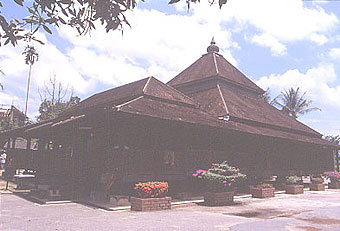
Built in the 1730's, the mosque is representative of architectural styles that reflect most of the characteristics of traditional local architecture. The architectural styles like those of local houses and buildings of that era are influenced by a number of factors such as the climatic conditions, the availability of building materials, the ethnic background and local craftsmanship. For the Kampung Laut mosque, only the most skilled local wood carvers and builders were commissioned to build the structure. As it was built close to the Kelantan riverbank, the mosque was raised on stilts, about 1m(3feet) above ground level to avoid floods that inundate the area during monsoon seasons.
 |
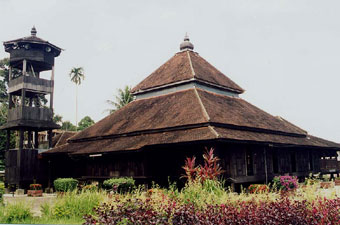
Four main columns support the upper most roof which is separated from the lower double-tiered roofs by timber louvres. This gap provides natural cross ventilation in the central area and also admits light. The roof is shaped in 3 tiers and very much resembles the Agung mosque in Demak, Northern Java, Indonesia circa 1479. It is said that the square plan of the Kampung Laut mosque was probably modelled after the Agung Mosque. Since there is almost a unified agreement that there are marked similarities between the two mosques, then the Javanese influence on the architectural style of masjid kampung laut is evident in the tiered roofs. The shape of the roof resembles a peak or mount which in the Hindu religion is regarded as the sacred abode of the Dewa. In Malay mythology, the mounts are where the ancestors' of kings were believed to have come from.
In the early centuries before the arrival of Islam, the dominant religion was Hindu. Hence the structure of the roof is similar also to the early Hindu and Buddhist chandi.
The original mosque was not how we see it today. It was a basic structure with only four main pillars supporting the 3-tiered roof. The roof itself was woven with palm fronds and the entire mosque measured only 400 square feet in total. In the late 19th century (), the mosque became an important religious centre and scholars came from throughout the region to Kampung Laut. During this era, the mosque was expanded to include an additional prayer area along the qiblat wall. A minaret, an attic and a verandah were further added. 20 columns were raised to support the additions.
 |
Building materials were collected locally and every piece was painstakingly handcrafted to perfection. Like piecing a 'Lego' collection together, the cengal timber flooring and panelling were joined together using the technique of 'Tebuk-Pasak' or mortise and tenon. The entire structure of the mosque was put together without hammering a single nail. Roof tiles replaced palm fronds. Called 'genting' or hand-made clay tiles, each piece was carefully fitted to prevent leaking and was resilient to strong winds. Although alterations and improvements were made to the structure, strangely, the keepers of the mosques had overlooked the weak foundations of the mosque. Built by the riverbank, the constant flash floods such as the great flood of 1926 also known as 'Bah Air Merah' weakened the soil foundations but nothing was done until much later when another great flood in 1966 washed away a part of the mosque.
Realising the dangers posed by the location of the mosque, the Malaysian History Society proposed that the mosque should be moved to a safer area, away from the disintegrating riverbank. In 1968, Masjid Kampung Laut was dismantled and reassembelled at the grounds of the School of Islamic Studies at Nilam Puri. Then the task was set out to repair the damaged part of the mosque.
In , the mosque went through another change where modern amentities such as electricity, toilets and water were added on. A sitting area and a tower were further added. With the additions, the total built up area is now 74ft by 71ft. With additional funds for refurbishing, woodcarvings were added to the pillars and walls.
Masjid Kampung Laut is still an active religious centre and the mosque caters to the community residing at Nilam Puri. It is regarded as one of the most important living museums in Peninsular Malaysia.
Dated: 39th March 2001
Accommodation & Packages to Kelantan ~ Kota Bahru, Pantai Cahaya Bulan, Pulau Perhentian & Surroundings
Click here for History of Malaya
Peninsula Malaysia Historical Sites |
|
Negri Sembilan |
| Astana Sri Menanti (Palace) | Istana Ampang Tinggi (Royal Dwelling) | Kota Lukut (Fort) | Pengkalan Kempas (Archeaology) | |
Selangor |
| Bukit Melawati (Fort) | Jugra (Royal Dwelling) | Batu Caves | |
Terengganu |
|
Kuala Lumpur |
| Colonial Kuala Lumpur (Architecture) | Kuala Lumpur Old Chinatown | |
Perak |
| Gua Tambun (Anthropology) | Kellies Castle (Architecture) | |
Kelantan |
|
Kedah |
|
Melaka |
|
Sabah & Sarawak ~ Borneo Historical Sites |
|
Sarawak |
| Niah Caves | |
 Getting There and Away
 Best Time to Go