Kuala Lumpur's story dates back to the 1820's when Malays, mainly Sumatrans crossed the Straits of Melaka to conquer the thick virgin jungle in search of a new life. They paddled up the Klang River and settled on the upper reaches of the river. We hear of such early Malay settlements in areas like Petaling about 17km from the city centre and a village called Kampung Haji Abdullah Hukum close to Jalan Bangsar about 12km from the city centre. These early settlers supplemented their meagre earnings from paddy and panning for tin at streams nearby.

Tengku Kudin Ibni Al-Marhum Sultan Zainal Rashid of Kedah married Tengku Arfah, daughter of Sultan Abdul Samad of Selangor in 1867. Tengku Kudin was appointed viceroy to settle a quarrel over Klang between sons of Raja Abdullah and Raja Mahdi.Courtesy of Arkib Negara |
Raja Abdullah, the Malay Chief governing almost the entire Klang Valley at the time had been eyeing for a part of the small but profitable income the villagers received from panning tin in the rivers. In 1857 he made a shrewd decision to send a party of 87 Chinese miners upriver from Klang to prospect for tin in the upper valley. It took them 3 days of river travel during the rainy season to get to Kuala Lumpur. If attempted during the dry season, the journey would have taken 10 to 15 days, with many occasions dragging boats over sandbanks or shallow waters. The miners and labourers disembarked and continued on foot to their destination from the confluence of Klang River and Gombak River where the water was too shallow to continue by boat. The going was tough - the intrepid travellers waded waist deep in swampy waters and were constantly tormented by mosquitoes and leeches. They headed towards the east to prospect at Ampang, which was reported to be rich in tin deposits. Being in unfamiliar territories, the head of the group engaged the expertise of a local magician or 'pawang' as known in Malay, to locate areas for mining. The pawang was thought to have favourable connections with the spirits of the jungle and was also very familiar with the terrain in the area. Once an area was located, a fee was further negotiated with the pawang for his consultation on ways to appease the local spirits to ensure that their progress in the area would not be hindered. However, things weren't as easy as they thought it to be.
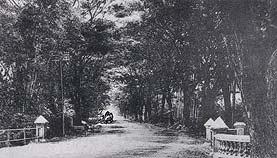
The first miners to arrive in KL headed on towards Ampang on this trail still used today. courtesy of Arkib Negara Malaysia |
Clearing the jungle around the mine brought an epidemic that killed many of the miners. Mosquitoes began to breed in large numbers, bringing with them malaria. Within the year, only 18 of the 87 miners survived. Yet upon hearing of the riches to be found here, more immigrants were sent to replace the fallen and soon a bustling trade bloomed. The Klang-Gombak junction, close to where Masjid Jamek is now situated, was the point for loading tin ingots and unloading of food supplies, weapons, shovels, pans, and more immigrants to man the mines. Persuaded by a local Malay chief, two pioneer Chinese traders of Hakka descent, Hiu Siew and Ah Sze set up their sundry shop at the confluence. Some regard these 2 traders as founders of KL others lean towards Raja Abdullah. The shop was strategically located on the right hand side of the Klang River facing upstream, to catch the miners before they made their way up the jungle tracks to the various mining areas.
It is not clear how the name Kuala Lumpur came about. Theories abound. 'Kuala' means estuary or confluence and in Malay usage, the name of the river or tributary that ends at this point should follow. Which means that this place should have been named Kuala Gombak but it wasn't. 'Lumpur' which means 'mud' could have been chosen because of the condition of the river. Another theory was that there used to be a tributary called Sungei Lumpur, which joined with the Gombak River just before the confluence. One thing is for sure.the significance of these waterways, the lifelines of a land can not be understated. The rivers gave Kuala Lumpur life and helped nurture the town from a mere seedling to a bustling Metropolis. It's unfortunate that by nature of development, rivers that had once been the epicentre of a growing township are now reduced to mere aesthetic swatches in this canvas of modernity. (And to some- just a large sewage system!)
Yap Ah Loy
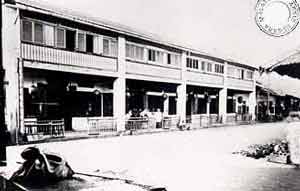
Yap Ah Loy's houses on market square, Kuala Lumpur 1884.courtesy of Arkib Negara Malaysia |
Perhaps the greatest figure in the rise of Kuala Lumpur was Yap Ah Loy. This young man left his village in Kwangtung, in the Southern China to seek fame and fortune in far-off shores purportedly lured by a recruiting agent with tales of wealth to be made in Malaya. He signed up, arrived in Malaya in 1854 at the age of 17 and worked as an immigrant labourer, later a cook and then a pig dealer before finding a position in a Chinese secret society. Powered by sheer tenacity, bravery and leadership quality, - all the makings of Captains of Industries, he ploughed his way to the position of first assistant to the Kapitan (captain) China within a short period of time. In 1868 Yap Ah Loy succeeded his predecessor to become the third Kapitan China of Kuala Lumpur. In those days, Chinese immigrants joined secret societies where they swore to serve and obey the rules of the society in return for mutual help such as decent burial rites, passage home to China etc. Migrants found solace in these extended families and most would turn to and were readily accepted by their own dialect groups and secret societies.

The old market square where Yap Ah Loy ran his businesses of Opium and gambling dens.courtesy of Arkib Negara Malaysia |
Yap Ah Loy belonged to the Hai San secret society, whose members were mostly Hakka as he was. A small man with a fiery temper and a reputation to match, Yap Ah Loy built his empire on the many tin mines in Kuala Lumpur. With autonomous rule over the Chinese community in Kuala Lumpur, he was vested with the power to control the gambling dens and brothels. As governor he also collected taxes from residents.
It has been said that during the more peaceful years under Yap Ah Loy's watchful eye, robbery was virtually eliminated. If a Chinese was found stealing, as first offence he would be dragged through the main street with the stolen loot tied to his back. The second offence would result in the slicing of an ear and the third offence, which of course only a kleptomaniac would attempt, resulted in execution.
Local Malays traded with the Chinese but lived apart as pigs were reared for meat in the vicinity. Being Muslims, eating pork is offensive to them. It was the Malays, who conferred the title Kapitan China on the headman of the Chinese community. The state's Malay Rulers who presumably faced communication difficulties with these newcomers, preferred to deal exclusively with one man and that would naturally be the headman. The Malay quarter rested on stilts along the east side of Klang River which was later named Java Street and now stands at Jalan Tun Perak. Goods were delivered here and passengers alighted enroute to mines in Ampang, Batu and Pudoh.
The main roads leading to these areas today preserve the old trodden tracks used by hundreds of mining coolies over 140years ago. Although, the Chinese were influential in the development of Kuala Lumpur, the Malays were the backbone of the society and maintained their position as traders and farmers growing garden produce and paddy for the community.
The British exchange
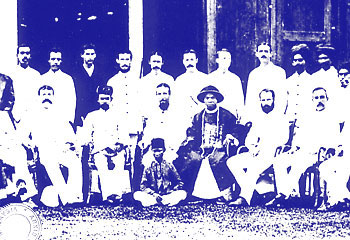
Prominent residents of Kuala Lumpur 1884. courtesy of Arkib Negara Malaysia |
When the British traded Bencoolen in Sumatra for Melaka with the Dutch, they further enhanced their stronghold in South East Asia. The British held rights to India and the Malay Peninsular, relinquishing all hold on the East Indies, which is now Indonesia. They realised that they had to consolidate their resources in South East Asia. The exchange was sealed in the Anglo-Dutch Treaty of 1824. Their control of Melaka port and the ousting of other European powers from the Malaya soil, marked the beginning of the British years in Malaya that spanned through 130years until Malaysia declared independence in 1957.
Having established the Straits Settlements in Penang, Melaka and Singapore, the British expanded their influence into the interior. One of the more advantageous position which gave the British a foothold into states such as Selangor and Perak was when they were called upon to arbitrate between the Malay rulers who were constantly at war with each other. Port Swettenham as Port Klang was known in those days, was the port- of-call and administrative centre of the state government of Selangor where the first Resident to Selangor was based. A Resident was the official representative, appointed by the Queen of England's commission with authority to rule the state in the name of the Sultan. However, the extent of the Resident's duties was not fully identified. There always seemed to be a grey area as to whether he was to only advise the Sultan in all non-religious matters or to act on behalf of the Malay Ruler. This was to complicate matters in the later years.
In March 1880, the directives from higher British authority in Singapore decreed that the administrative centre be moved to Kuala Lumpur, which by then was proving to be a 'happening' town and commercial centre. Having witnessed many uprisings in the country against intruding aliens, the handful of British officials set up their camps with full apprehension. Afraid that their intrusion into Yap Ah Loy's domain would create hostility and at worst, bloodshed - they sited the 'official quarter' on the opposite bank of the Klang River connected only by a rickety wooden bridge over the river to the main centre. The anticipated uprising never happened. Kuala Lumpur was by then growing at an astonishing rate. Yap Ah Loy realised that his method of governing was no longer effective and so readily accepted the British intervention.
The 'official quarter' was sited in a location just behind the Royal Selangor Club where Jalan Sultan Hishamuddin runs. The first Resident of Kuala Lumpur, Captain Bloomfield Douglas was a rather arrogant and pedantic commandeer, who was insensitive to issues apparent between the natives and the British. He chose a site on top of the mount overlooking the Gombak River to build his personal fortress. The site, now occupied by the Prime Minister's Office Complex, was equipped with a howitzer gun placed on the lawn, with which Captain Douglas made a parade of his authority by demonstrating to his visitors the accuracy of his weapon, lobbing missiles 'into selected targets in the jungle below'.
To the captain's disappointment, his superiors in Singapore namely Sir Frederick Weld, (the Administrator) and Sir Frank Swettenham (then the Assistant Colonial Secretary) rebuked his request for his ambitious plans for a fortress. Instead, his superiors decided to move the old Residency from Klang to Kuala Lumpur. Every brick and bit of timber of the double storey timber building presented by the native viceroy, Tengku Kudin to the first British Resident of Selangor in 1874 was dismantled and shipped to Kuala Lumpur. There was a lack of funds for the construction of a new town. The existing large government buildings in Klang faced the same fate. Not only was the State Government administrative power shifted from Klang to Kuala Lumpur, the entire centre - brick, mortar and all was physically and laboriously transferred. Not long after the move, Captain Bloomfield Douglas was himself removed from office and was replaced by Sir Frank Swettenham.
Sir Frank Swettenham
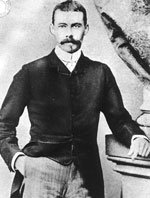 |
Frank Swettenham was no stranger to Kuala Lumpur. In 1875, he came to Kuala Lumpur on an official visit where he met Yap Ah Loy for the first time. Swettenham was well impressed with the Kapitan China, recording in his journal, 'I went straight to the house of the Captain China..he offered me champagne, but that I declined, preferring excellent beer which I certainly never expected to find here. It was by far the best mining village I have seen, the streets wide and excellently arranged, the shops most substantial.in front of the Captain's house are the Gambling Booths and the market.there are about 1000 Chinese in the town and some 500 to 700 Malays.'
However things were beginning to change. In 1879 along with the second rise in world tin prices, an influx of Chinese miners to open more mines contributed to an increase in population. Within a year the Chinese community had ballooned to 4000 people. Residents disposed of their refuse onto the streets. Swettenham later complained, ' the refuse of the drains is simply removed therefrom and laid on the side of the road.. smallpox, cholera and fever break out here very often.' Filth, disease and the stench were only the start of the problem. Fire broke out periodically and with inadequate fire fighting equipment except for a bucket of water in every household standing ready to combat fire as directed by Yap Ah Loy, little could be done to contain the fire. On 4th January 1881, an overturned oil lamp in an opium den spread quickly and in no time had engulfed the town. The settlement of about 500 houses was rebuilt with bricks and tiles instead of timber ply, mud walls and palm thatch roof. The cost of rebuilding the town was borne by Yap Ah Loy. This may have been the beginning of town planning in Kuala Lumpur.
Padang Merdeka
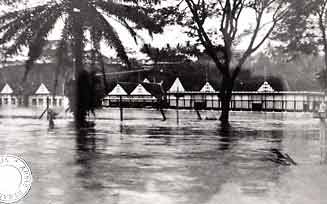
Selangor Padang 1926 flooding. courtesy of Arkib Negara Malaysia |
Plans were also well underway on the other side of the river by then. Buildings from Klang were reconstructed overlooking the swampy land on the West Bank of the Klang River. The land area here was levelled and drained for the police to conduct their drill. This area was initially named the Parade Ground and was renamed Dataran Merdeka or Merdeka Square in 1957. The padang itself, padang meaning field in Malay, has been the integral part of many memorable events throughout the course of KL's history. This was where the course of a new nation was charted when the British lowered the Union Jack for the last time and independence was declared on a clear evening, 30th August 1957.
In the early days of British settlement, the police headquarters appropriately called 'the Fort' was sited on a vantage-point overlooking the Padang. The police barracks were built on lower ground nearer the Padang at Jalan Raja. The Federal Police Headquarters now occupy 'the Fort', renamed Bukit Aman. In 1880, a large part of the padang was swampy area. On more levelled ground at the edge of the padang, there were vegetable gardens.
More on Kuala Lumpur's Colonial influences ...
Accommodation and Packages to Kuala Lumpur , KLIA , Petaling Jaya, Damansara , Subang , Sunway, Putrajaya, Kuala Kubu Bahru , Kuala Selangor, Klang and Surroundings
Malaysia Cities , Towns & Villages
Peninsula Malaysia Cities , Towns & Villages |
|
Kedah |
| Alor Setar | |
Terengganu |
| Chukai | Dungun | Kemaman | Kijal | Kuala Terengganu | Paka | |
Perak |
| Ipoh | Kuala Kangsar | Lumut | Taiping | |
Selangor |
| Klang | Kuala Selangor | |
Kelantan |
| Kota Bahru | |
Federal Territory |
| Kuala Lumpur | |
Johor |
| Mersing | |
Negri Sembilan |
| Seremban | Kuala Pilah | Lukut | |
Pahang |
| Sungei Lembing | Kuala Lipis | |
Melaka |
| Melaka | |
Sabah and Sarawak Towns , Cities & Villages |
|
Sarawak |
| Kuching | Long Bedian | Long Lama | Long Terawan | Miri | Marudi | |
Sabah |
| Sandakan | Kota Kinabalu | Tawau | |
 Getting There and Away
 Best Time to Go
 Food in the city
  Art & Entertainment
 Shopping
 Nightlife