Istana Bandar
 |
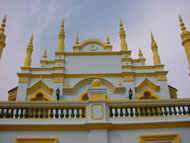
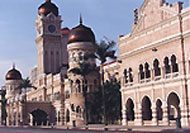
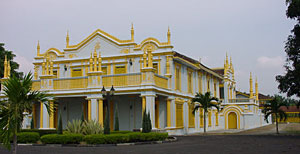
The fifth Sultan of Selangor, Sultan Alauddin Sulaiman had a dream. He visualised a big palace made of wood and marble, with fifteen rooms to cater for countless royal functions. He would design for his Queen a spacious and beautiful courtyard where she could repose and enjoy her moment of quietude. He would also need a grand balcony from where he would stand behold, while addressing his subjects. In keeping with Malay architecture, the roofs of the palace would be adorned with trimmings of intricate wooden carvings.
In 1905, his dream came to life. Sultan Alauddin remained in residence at Istana Bandar for 35 years. From this palace he governed, received numerous important British and foreign dignitaries, held important official and religious ceremonies, and taught his descendants the strategies of becoming powerful rulers.
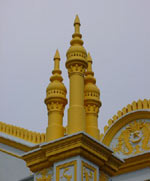
Take your time to dissolve into this realm that Sultan Alauddin had created. Be captivated by its fascinating architecture. There are unmistakable marks of Islamic influence in its aesthetic design - a delightful blend of Indian and Middle Eastern elegance; all this inspired Sultan Alauddin in building his dream palace. Masterful craftsmen from China were shipped in, their skills utilised in the making of wooden carvings, adding a dash of Chinese brilliance in the general overall artistry.
 |
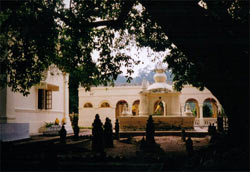
An enfolding atmosphere of romanticism permeates throughout the grounds of Istana Bandar. A huge tree stands guarding the courtyard, magnanimously stretching its arms providing a generous canopy. This rouses visions of the Queen sitting gracefully in a swing strung from a sturdy branch. Ladies-in-waiting gently pushing the swing to sway smoothly and lightly. Before the great Lady, courtiers sit around entertaining her with melodious songs and beautiful smiles.
Wander around the back, and you will find an altogether different domain. This must have been the dominion where the loyal servants reigned. Small rooms with tiny windows for them to bunk in. Spacious long halls for them to dine and mingle. Perhaps to have a game of congkak or may be even checkers. And probably also where senior servants reaffirmed the rules of the House, and disciplined the irresponsible and the neglectful.
 |
Today, Istana Bandar still stands. Regrettably, unlike its glory days, it lives a solitary life, destitute of its genteel inhabitants. Its rooms are quiet and empty. Its grounds no longer hears the sweet serenade of the ladies-in-waiting. Istana Bandar now shares its compound with the Centre for Quranic Studies. It also plays host to the Islamic Department of Selangor. According to a friendly local, during the fasting month of Ramadhan the Sultan returns to Istana Bandar to listen to the recitation of the Quran. Happily, during this holy month, Istana Bandar once again glows as it reminisces the happier memories of days gone by.
Bukit Jugra
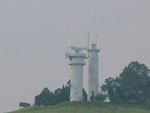 |
Many ships had tried, but all of them failed to reach the beaches that support the elevation which the locals called Cockle Hill. These late19th century navigators had been travelling for weeks along the Straits of Malacca, and each time they closed in, the shores sneakily moved backwards further inland, breaking these mighty armadas to yield frustration. The English wanted no more of this nonsense. So, they constructed a lighthouse on top of Cockle Hill. And from then on, deep in the night, when everything was still and the locals were all snuggled and asleep on their woven mats, a beacon of light would part the darkness looking for ships welcoming them to the shore.
And that is how the legend goes; and it goes on to tell the story of how the hill continued to bleed for 30 long days after the erection of the Sri Jugra Lighthouse. The waters surrounding it assumed the rusty-red colour of the cockles that resided there. Ironically, not long after the incident, the cockle population started to dwindle, and then they all disappeared.
But then again, this is all folklore, romanticised tales to spice up an event. Much of the earlier history of Malaysia was passed on by the 'penglipurlara' or storytellers. They frequented little villagers to update the people on important affairs. The more colourful the story was, the greater the crowd he would gather. Thus, his tales needed to be exciting. And never mind if it blurred the line between reality and fiction. And that is just why the coastal land could be cheeky and unwelcoming,, and the cockles all died away without any logical explanation. After all, isn't inexplicable tales part of the mystification surrounding all legends.
Today, people and not ships flock to Bukit Jugra (Jugra Hill). Right from the base of the hill, they jog all the way up the winding road in their cross trainers, carrying their bottles of water. Fathers and sons, mothers and daughters, scaling the hill for the ultimate cardio experience.
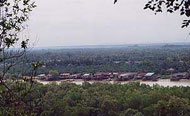
Not all who visit Bukit Jugra are there for the exercise though. Young girls and their boyfriends, while on their brief recess from looking into each other's eyes, throw their glance away to admire the spectacular view of the Langat River that cleaves the lowlands, winding and curling as it meanders sinuously to converge with the river mouth. Nowhere else can Selangor boast a peak from which one can be inspired by such a spectacular landscape. Its picturesque panorama stretching into the horizon, reaching mountainous divides, and transgressing beyond the Straits of Malacca, and at times almost into oblivion.
 |
If you are planning to venture into the unbridled Bukit Jugra, be prepared to lose some centimetres off the sole off your shoes from all that walking, be blown away by the sprawling scenery, and perhaps lose a few ringgit on the purchase of water and refreshments. Expect activity, because the main attraction here is just that; and this pretty much rules out a social call to see the master, the immortal lighthouse. Within its compound, all is unmoving, somewhat idle. Everything is silent. Only, and only if you listen hard enough, you might just hear the quiet and unimposing humming the lighthouse makes as its light goes round and round in a circular motion, day and night, night and day. A lonesome edifice, solitary and isolated within its neat compound that welcomes no visitors.
Next Page on village life at Jugra...
It is recommended to take day trips to Jugra from Klang or Kuala Lumpur. Please refer to Klang for more on accommodation closer to Jugra or Kuala Lumpur if you wish to stay in the city.
Accommodation and Packages to Kuala Lumpur , KLIA , Petaling Jaya, Damansara , Subang , Sunway, Putrajaya, Kuala Kubu Bahru , Kuala Selangor, Klang and Surroundings
Click here for History of Malaya
Peninsula Malaysia Historical Sites |
|
Negri Sembilan |
| Astana Sri Menanti (Palace) | Istana Ampang Tinggi (Royal Dwelling) | Kota Lukut (Fort) | Pengkalan Kempas (Archeaology) | |
Selangor |
| Bukit Melawati (Fort) | Jugra (Royal Dwelling) | Batu Caves | |
Terengganu |
|
Kuala Lumpur |
| Colonial Kuala Lumpur (Architecture) | Kuala Lumpur Old Chinatown | |
Perak |
| Gua Tambun (Anthropology) | Kellies Castle (Architecture) | |
Kelantan |
|
Kedah |
|
Melaka |
|
Sabah & Sarawak ~ Borneo Historical Sites |
|
Sarawak |
| Niah Caves | |
 Getting There and Away
 Best Time to Go