Kuala Lumpur’s story began in the 1820’s. Malays, many from Sumatra had crossed the Straits of Melaka, hacked through thick virgin jungle and paddled up the Klang River to settle along its upper reaches. We hear of such early Malay settlements in areas such as Petaling about 17km from the city centre and a village called Kampung Haji Abdullah Hukum close to Jalan Bangsar about 9km from the city centre. These early settlers supplemented their meager earnings by planting paddy and panning for tin in streams nearby. Even such crude methods used in extracting the mineral, the positive reports of rich tin deposits in the area raised quite a bit of interest.
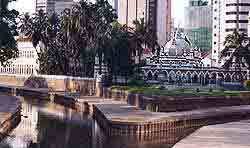
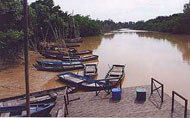
The confluence where early miners alighted in wait for their ‘kepala’ or mine manager guide them to the mines. |
Raja Abdullah, the Malay Chief governing almost the entire Klang Valley, was especially interested in making profits from tin. In 1857 he made a shrewd decision to send a party of 87 Chinese miners upriver from Klang to mine for tin in the upper valley. It took travellers 3 days of river traversing during the rainy season to get to Kuala Lumpur and if attempted during the dry season, the journey took 10 to 15 days. A hard journey with many occasions of dragging boats over sandbanks or shallow waters, with wild, ferocious animals lurking at every corner and having to cope with bouts of malaria and other tropical diseases.
Miners and labourers arriving at the confluence of Klang River and Gombak River disembarked on the sandbank, where they continued on foot through vague jungle paths heading to the mines. The early mines were located to the east of the confluence, at a place called Ampang. So began the arduous task of prospecting. Being rather superstitious people, the Chinese prospectors engaged the help of a local magician or ‘pawang’ as known in Malay, who purportedly had favourable connections with the spirits of the jungle. Armed with some knowledge of the area’s geology supplemented with incantations, the ‘pawang’ was hired to locate areas for mining. If tin was found, a fee was further negotiated with the pawang for his consultation on how to appease the local spirits to ensure that their progress in the area was not jinxed.

Old Jalan Ampang, one of the busiest roads in Kuala Lumpur. Courtesy of Arkib Negara |
The miners began work on the selected area by damming the streams, rivers and bogs so that they could excavate the water logged area. Hence the area was aptly named Ampang - meaning Dam. However, the clearing of jungle in the area exacerbated the harsh conditions, which the immigrants already had to endure in this untamed, foreign land. Mosquitoes began to breed in large numbers, bringing with them, a spread of malaria. Within a year, only 18 of the 87 miners survived. But yet upon hearing of the riches to be found here, more immigrants were sent to replace the fallen and soon a bustling trade bloomed.
The Klang-Gombak junction, close to where Masjid Jamek is now situated, was the point for loading tin ingots and unloading food supplies, weapons, shovels, pans, and more immigrants to man the mines. Boats meandered up and down the river and Raja Abdullah prospered beyond his imagination from these mines.
Persuaded by a local Malay chief in the Ampang area, two pioneer Chinese traders of Hakka descent, set up their sundry shop at the confluence. Some believe these 2 traders as founders of KL where others lean towards Raja Abdullah. Their shop was strategically located on the right hand side of the Klang River facing upstream. They did brisk business selling all sorts of provision to new labourers and miners disembarking at the jetty. These two Chinese traders later became powerful members of the Chinese Secret Society in KL.
It is not clear how the name Kuala Lumpur came about. Many theories were formed to satisfy this. ‘Kuala’ means estuary or junction and in Malay usage, the name of the river or tributary that ends at this point should follow. Which means that this place should have been named Kuala Gombak but it wasn’t. ‘Lumpur’ which means ‘mud’ could be used to attribute the condition of the river. Another theory was that there used to be a tributary called Sungei Lumpur, which joined with the Gombak River just before the confluence. With all the theories, one thing was certain, Kuala Lumpur began as a trading post at this river junction, which gave it its name that has remained to this day.
The significance of these waterways, the lifelines of a land can never be disregarded. However, by nature of development, rivers that had once been the epicentre of a growing township are now reduced to mere aesthetic swatches in this canvas of modernity.
Yap Ah Loy
 |
One man instrumental in the rise of Kuala Lumpur was Yap Ah Loy. This young man left his village in Kwangtung, in the Southern province of China to seek fame and fortune in far-off shores, apparently lured by a recruiting agent with tales of wealth to be made in Malaya. He signed up, arrived in Malaya in 1854 at the age of 17 and worked as an immigrant labourer, later a cook and then a pig dealer before finding a position in a Chinese secret society.Powered by sheer tenacity, bravery and a fine demonstration of leadership quality especially during the Selangor Civil War, Yap Ah Loy found himself a group of loyal fellowmen who were prepared to fight under his commands.
He ploughed his way to the position of first assistant to the Kapitan China within a short period of time. In 1868 Yap Ah Loy succeeded his predecessor to become the third Kapitan China of Kuala Lumpur.
In those days, Chinese immigrants embarking on a new life far from home were initiated into secret societies where he was sworn to serve and obey rules of the society in return for mutual help such as decent burial rites, passage home to China etc. These hapless men found solace in their ‘extended families’. Most would turn to and are readily accepted by their own dialect groups who in turn formed their own secret societies. Once again assuming communication difficulties, as there are numerous dialect groups in China, it makes sense to associate with groups of people who one can communicate with.
Although KL was then already teeming with overzealous Chinese immigrants, there were also the local Malays who traded with the Chinese but lived away from the them. Malays being Muslims, view eating pork as offensive and the Chinese had a fondness of rearing pigs within their living quarters.
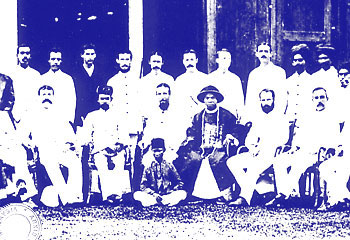
The influential men of Kuala Lumpur during the late 1800’s. Yap Ah Loy being the most prominent figure. Courtesy of Arkib Negara. |
A short distance away from the chinese quarters, the Malay quarter rested on stilts along the east side of Klang River which was later named Java Street, where goods were delivered and passengers alighted enroute to mines in Ampang, Batu and Pudoh. The main roads leading to these areas today preserve the old trodden tracks used by hundreds of mining coolies over 140years ago. It was the Malays, who conferred the title Kapitan China on the headman of the Chinese community. The state’s Malay Rulers, who presumably faced communication difficulties with these newcomers, preferred to deal exclusively with one man and that would naturally be the headman hence the Kapitan, ie more often than not, the head of the most powerful secret society.
Although, the Chinese were influential in the development of Kuala Lumpur, the Malays were the backbone of the society and maintained their position as traders and farmers growing garden produce and paddy for the community.
More on Kuala Lumpur's Chinatown ...
Accommodation and Packages to Kuala Lumpur , KLIA , Petaling Jaya, Damansara , Subang , Sunway, Putrajaya, Kuala Kubu Bahru , Kuala Selangor, Klang and Surroundings
Malaysia Cities , Towns & Villages
Peninsula Malaysia Cities , Towns & Villages |
|
Kedah |
| Alor Setar | |
Terengganu |
| Chukai | Dungun | Kemaman | Kijal | Kuala Terengganu | Paka | |
Perak |
| Ipoh | Kuala Kangsar | Lumut | Taiping | |
Selangor |
| Klang | Kuala Selangor | |
Kelantan |
| Kota Bahru | |
Federal Territory |
| Kuala Lumpur | |
Johor |
| Mersing | |
Negri Sembilan |
| Seremban | Kuala Pilah | Lukut | |
Pahang |
| Sungei Lembing | Kuala Lipis | |
Melaka |
| Melaka | |
Sabah and Sarawak Towns , Cities & Villages |
|
Sarawak |
| Kuching | Long Bedian | Long Lama | Long Terawan | Miri | Marudi | |
Sabah |
| Sandakan | Kota Kinabalu | Tawau | |
 Getting There and Away
 Best Time to Go
 Food in the city
  Art & Entertainment
 Shopping
 Nightlife