Traders Cave
traders cave |
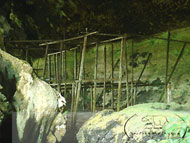
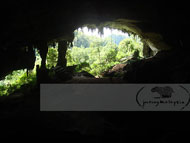
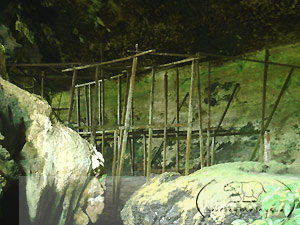
Before the area was gazetted as a National Park in 1975, access to the caves was difficult. The soggy bog was a trudge. Bird nest Traders and even early archaeologists who discovered the burial site at Niah Cave spent for weeks or months at a time. The traders brought in enough food supply for their long stay and camped out at Trader's Cave. This is the first of the 'chambers'. It was a little unexpected though, upon entering this area it's no wonder the name. A long row of stilted structures lined the inner walls of this brightly lit cave. Trader's cave is not so much a cave but more an overhang. The wooden frames of these temporary housing for traders are visitors first evidence of human use of the caves as shelters. The presence of these structures gave a certain chill down my spine. The coolness in the cave and the quiet wind billowing, the damp, unfamiliar smells, the old, used cobwebs wafting as I walked past. Short walk towards the opposite end, I stumbled onto an old playground.. A ball court with its perimeters and court lines well etched into the solid ground. All at once, it felt less scary. Familiarity sinks in.
Great Cave
 |
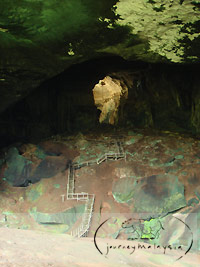
Up the stairs and into the sun again, walking along the ledge of the limestone wall.. leads me into the west mouth of the Great Cave . The first thing that struck me was a dig. Behind the fencing was where the archeological digs in 1957 first began. Under the flagship of Sarawak Museum and supervision of the museum curator, Tom Harrisson work was carried out meticulously; painstakingly removing small amounts of soil to reveal artifacts, history and life stories of the early inhabitants who came to Borneo and stayed possibly some 40,000years ago.
 |
Tom Harrisson excavated what is believed to be the oldest human skull in South East Asia . The cave was believed to be inhabited by the Australo-Melanesian group before being completely replaced by the Austronesians. In the years of the early peoples, during the Ice Age period - Niah cave was probably 200km further inland than it is now, when sea level was much lower and there was creation of land bridges connecting existing islands with mainland. Large animals such as rhinoceros, tapirs and giant pangolins roamed the land. During the Halocene period, as the jungle became denser, these large animals disappeared and when the sea level rose.. the inhabitants diet changed to shellfish as found in the cave's dumpsites.
 |
West Mouth was also used as a cemetery area from 13,000 to 3,500 years ago. Together with the dead, were burial items such as pottery and adzes, bronze bangles, beads and metal items showing the emergence of beliefs of the netherworld, somewhere dated around 2000BCE. Secondary jar burials were also found here, one was radiocarbon dated to the late 2 nd millennium BCE. In these types of burials, locally made jars are used to hold cremated and burnt remains. Together with this type of burial is the double-spouted earthenware vessel that is buried together with the deceased's remains and is believed to be used specially for funerary purposes. Log coffins were also found in the Great Cave believed to date from the Stone Age. These log coffins were found in poor condition of preservation as they were normally cut from soft or medium wood quality. Log coffins of the later era were normally made from hardwoods such as belian because of the discovery and use of iron cutting tools.
Another cave that was used as a burial site is the Gua Kain Hitam or The Painted Caves.
The Large Chamber or Padang
To the back of the Great Cave, flights of wooden steps takes me through a gaping hole into another cavern known as the Padang or Large Chamber. It is here that visitors may be able to catch the birdnest harvesters in action. There are bamboo and rattan ladders leading into tiny holes in the ceiling. The walk becomes more difficult as I shuffle along the slippery wooden walkway.
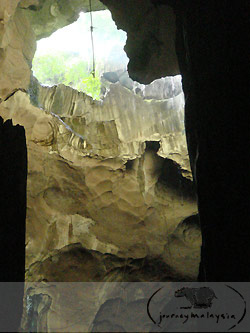
a rattan/bamboo ladder leads to the ceiling of this cave - where the harvesters collect the swiftlet nests |
Along the way, certain areas are illuminated by sun streams beaming down from holes or cave ins on the ceiling of the cave. In the old days traders, harvesters, guano collectors and their families would congregate in the caves to conduct a ceremony appeasing the Gods so that they would have a safe and bountiful harvest.
Soon after, the cave darkens. I had a large torchlight with a powerful beam. The dark tunnel leads into the Moon Cave . Being in total darkness, not knowing what's beyond the torchlight's finite beam is scary. It doesn't help if the plank walk gets more difficult to grip and slipping off into the unknown is possible; and when I have no choice but to cling on to the guano encrusted railings.wishing as I inched my way that I had prepared myself better and brought gloves.
The Painted Cave or Gua Kain Hitam
After what seems like hours, the walk spits us out into a smaller Moon Cave . Trying to adjust my eyes to the light at the mouth of the cave.. I carry on. The walkway resumes into the open area. It feels good for a breath of fresh air after the slightly claustrophobic 1/2hour walk. This last leg of the walk takes visitors to the final cave in this system; well the ones open to public. The cave received its name supposedly from the barter trading and one prized item was bales of black cloth bartered for the birdnests amongst other items such as salt, pottery, food etc.
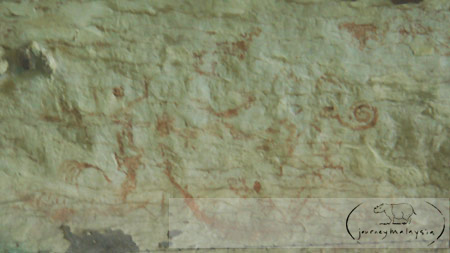
faint hermatite drawings to the back of the cave. it's difficult to make it out initially, but after a while of squinting, you may be able to see drawings of humans and sampans along the length of the wall |
This cave is small but airy and towards the right of the cave is a fenced area. On approaching the fence, I looked deep into the back wall, squinting. As my eyes adjusted to the lighting condition in the cave, the paintings became cleared. There was a line of drawings created in red hermatite or red ochre along the walls. These drawings were first documented by art historian Barbara Harrisson in 1958. About 100 individual drawings were recorded stretched along 50m. The motifs are mainly of human figures and boats. This could possibly be the burial rites and beliefs documented by the early dwellers as several 'boat coffins' were found nearby. It was believed that the spirits of the dead were taken on a journey to the underworld by boat.
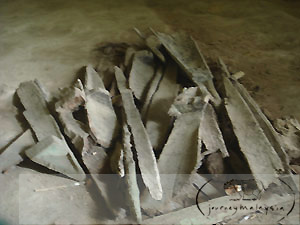
boat splinters left on the cave floor |
This cave was discovered by Barbara Harrisson in 1958. Scattered among the coffins she also found human bones, pottery shards, shells and coloured beads. The burials found at the painted cave are secondary burials which mean that the bones were exhumed and reburied. It is believed that this burial site was for members of a higher status and was further reaffirmed by the artifacts that were buried with the remains such as Chinese stoneware, carved bones, imported glass beads, bronzeware, and local pottery including the double spouted vessel. The associated artifacts also date the burial sites as being some 1,000yrs ago from the presence of Tang and Sung Dynasty Chinese stoneware. Another telltale sign that those buried here had important standing in the community is the polished, solid ground area at the cave mouth - possibly stamped down and refined during heavy ritual or mass dancing conducted at ceremonies.
As I backtracked my way through the dark tunnels into the caverns, images passed me by. beings that inhabited these caves, died and were buried here. How would it have been thousands of years ago; was there a hierarchy? When did they become an organised community? Who were their enemies? What were they most afraid of? What became of the early settlers? Did the early man of Australo-Melanesian origins disappear before the arrival of the Austronesians or did their paths cross and the weaker was defeated? So many questions.if only the answers were written on the walls.
Next Page For Niah National Park...
Accommodation and Holiday Packages to Miri, Bintulu, Sibu, Labuan, Mulu , Bario Highlands and Surroundings
Malaysia Rainforests, Sanctuaries and Parks
Short Adventure & Nature Trips
Click here for History of Malaya
Peninsula Malaysia Historical Sites |
|
Negri Sembilan |
| Astana Sri Menanti (Palace) | Istana Ampang Tinggi (Royal Dwelling) | Kota Lukut (Fort) | Pengkalan Kempas (Archeaology) | |
Selangor |
| Bukit Melawati (Fort) | Jugra (Royal Dwelling) | Batu Caves | |
Terengganu |
|
Kuala Lumpur |
| Colonial Kuala Lumpur (Architecture) | Kuala Lumpur Old Chinatown | |
Perak |
| Gua Tambun (Anthropology) | Kellies Castle (Architecture) | |
Kelantan |
|
Kedah |
|
Melaka |
|
Sabah & Sarawak ~ Borneo Historical Sites |
|
Sarawak |
| Niah Caves | |
 Getting There and Away
 Best Time to Go
 Nature activities
 Niah National Park and Surroundings accommodation & packages ...
 Malaysia Historical Sites