NEWSFLASH ! Once again, the tussle between economics and environment is turning out that environment is losing the battle. Logging has now crept into the Temenggor area and loggers are happily at work, turning 170million year old rainforests to hardwood material for ever hungry consumers in Asia, Japan, The USA and Europe. Precious research areas are being torned down to make cheap furniture and toothpicks - all disposable, all dispensable. The rainforest wont be growing back anytime soon especially when the rain sets in and washes away the top soil. All we will have is a scar and what may be even worse - more palm oil plantations or acacia forest plantations. Monotone will be the landscape soon if we dont voice out our concerns. You can in fact do that. Have a read about the situation at Temenggor and Belum area at
 |
Total coverage of the forest reserve is reported to be about 290,000 hectares. The Belum area is divided into lower and upper sections.The Upper Belum area covers 117,500hectares of inpenetrable jungle which stretches into the Thai-Malaysian border. This vast jungle patch acts as a natural barricade and is gazetted a security zone. Belum and Temenggor reserve parks have been left pretty much intact because the State of Perak has decided to preserve the area as a permanent nature reserve for research. The Upper Belum is of 90% virgin forest whereby the lower half is generally covered by secondary forest. That's a lot of good jungle cover to research on!!!
Much of our prescribed medicines were distilled from herbs and plants. Researchers from all over the world are racing against time to find cures for diseases and ailments such as
Cancers, Alzheimer's, Parkinsons, Meningitis etc. They believe the elixir is locked in the secrets of the rainforest plants. But rainforests are being cut down at such astonishing rates, we may one day destroy the Garden of Eden hidden within and destroy all hopes of cures for our diseases.
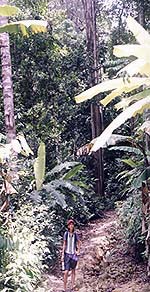
Belum, belum, beluuuummm! This is the sound made by a large grasshopper that makes it home in the jungle. Hence, the name. Although most of the adventure packages will take you through secondary forests, there are areas in Lower Belum that is pegged with huge Meranti, Cengal, Keruing and Merbau species. These are names of rainforest hardwoods that are becoming increasingly rare. The rainforest soil is surprisingly poor in nutrients.
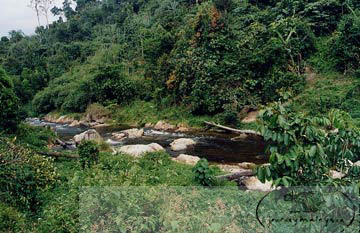
Numerous streams and brooks bring fresh water from the hills into the lake |
Once an area is exposed, the remaining nutrients in the soil easily leaches away and what lies underneath is clay and sand. If you have the time, try digging into the earth. The black, rich soil covers only the top thin layer, underneath is a desert of lifeless base. It is a wonder that anything can grow at all. But it does. This unfaultable ecosystem has been thriving and weathering changes for over 150million years. Many of the large hardwoods you may see around you have survived 150 to 600years of weathering. That is already a heritage worth saving.
Belum is rich beyond any comprehension. But how can it be? Many would not be able to identify with the importance of this ecosystem. Many people see the jungle as unkempt backyards that need to be tidied and cleaned up so that we can use it as another playground or work space. That is exactly what happens to many of our pockets of jungles, let's hope that life will be sustained at Belum!
Treasures
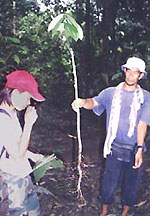
guide showing us the variety of plants and herbs collected for research |
Treasures may not always be there glistening for all to see. The real treasures are always hidden and it takes a while to find. After our boat ride round the lake and the trek to the salt lick, we ended up at another Orang Jahai village, where we were introduced to the head of the village. He was happy to see our guide for he had lots of treasures for him. We were a little puzzled as to what he was to do next. The headman dragged out a bulging gunnysack from under the bamboo hut and turned the sack inside out.
‘Your loot’, he said. The guide was delighted. Tied up in neat bundles, were all sorts of vegetation harvested from the area. These plants looked pretty ordinary to us. Some lianas, several types of roots, leaves, bulbs…looked like someone had just cleared his garden of weeds. These, we were told, each contained powers of healing. The plants were medicinal herbs that have been collected and used by the orang asli for generations. All types of ailments could be ‘fixed’. Even love potions can be arranged…with a dash of ‘cenuai’ to complete the potion. Not to mention the tongkat ali and the rafflesia buds.
We were transfixed. We were awed. We were reduced to mere goggled-eyed schoolgirlies...
But what of the Rafflesia?
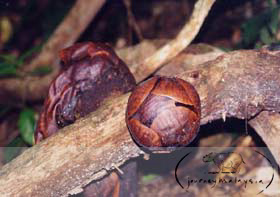
These are rafflesia buds, becoming extremely rare as they are harvested by the orang asli and sold to villages for a mere few ringgit. The locals boil it to remedy the womb. |
The Rafflesia is a strange plant…. the fact that when it is in bloom, it stinks to high heaven, gives enough weight. Unlike other plants, there are no leaves to process carbon dioxide and sunshine into sugar and oxygen.
There are no roots to soak up water and minerals from the earth to manufacture into proteins. What is found are long strands of tissue-like filaments that penetrate the vines of the host plant. Host plant? Well, yes…. Rafflesia is a parasite which means that it doesn’t need to make its own nutrients. It just sucks the nutrient out of its host which is, another plant. The large fleshy flower is what we usually notice. This is the flower’s sexual organ, sometimes found sitting on an overhead vine or usually languishing in the damp forest floor below. The reddish brown colour of the petals, sprinkled with white freckles exudes a most unpleasant stench, similar to rotting flesh or carrion. Some believe that the stench attracts flies and other insects which help disperse its seeds. Others believe that large animals could be agents for this seed dispersal. In order for the seed to germinate, it was found that the vine of the host plant must be damaged in some way so that the filaments of the seed may infiltrate successfully. The damage to the host vines could be made by trampling hoofs of large animals. The seeds adhere to the passing animals’ hoofs and are transported to other places where they can find host plants to attach to. This cannot be disproved or proved. However, it is found that the flowers most often occur in big game areas and less in other areas.
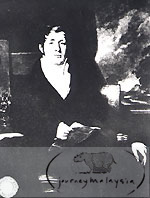
Sir Stamford Raffles. photo courtesy of arkib negara malaysia |
There is even more to tell of its ‘discovery’ and its claim to fame as the largest flower on earth. In the year 1818, Sir Stamford Raffles was posted as Governor to Bencoolen in Sumatra which was then, the administrative centre for the British East India Company for Western Sumatra. Raffles’ interest in natural sciences was insatiable. A respected and popular member of the Royal Society in London, Raffles arranged and persuaded a fellow society member - Dr.Joseph Arnold to accompany him on an expedition into the interiors of Sumatra. It was on one of these expeditions that they stumbled on a discovery which was to puzzle botanists for a long time. Unfortunately, Dr Arnold died too soon of jungle fever, before presenting the report to the society. The new found flower was given the scientific name, 'Rafflesia arnoldii',in honour of the two gentlemen.
Accommodation & Packages to Perak ~ Ipoh, Gopeng, Taiping, Lumut , Pulau Pangkor, Maxwell Hill , Kuala Kangsar, Belum and Surroundings
Malaysia Rainforests, Sanctuaries and Parks
Short Adventure & Nature Trips
 Getting There and Away
 Best Time to Go
 Lake Activity - Trek etc