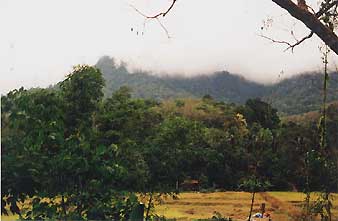
Krau Reserve - a reserve set aside mainly for wildlife research only. Will the captive seladangs be set free eventually into this tiny reserve or will poaching render such an important move, futile? |
There are plenty of articles featuring the wonders and abundance of wildlife in our tropical rainforest jungles. No doubt the animals are there but few actually realise how difficult it is to spot large animals while out on a stroll in the jungle. Unlike wild, open plains of African lands often shown in documentaries; the rainforest jungle is compact, enclosed, stifling and confusing. However, if we were to stop to observe, there are definitely lots to see. Wild animals have a keen sense of smell and they have acute sense of hearing. More often than not, they are able to sense our presence long before we can theirs. An animal even as large as the elephant or a seladang can 'disappear' behind the curtain of thick, almost impenetrable foliage and you wouldn't even know they are there. Just a few steps away from you!
The other alternative for animal spotting is to visit the zoo. But that would be a little too convenient wouldn't it?
In Malaysia, there are wildlife sanctuaries set up around the country with the sole intention of increasing the number of endangered species such as elephants, sumatran rhinos, the seladang, deer, river terrapins, sea turtles etc. and hopefully release them back into their natural habitats when the time comes for them to return.
There was a time, not too long ago when jungle covered most of the lowlands and highlands of the Peninsular. Animals had large tracks of land to roam freely without fear of man and his activities; for he lived far away in towns and villages. Then came a time when the sounds of chainsaws resonated through the jungle. Dull thuds of giant trees falling to the ground filled the jungle with commotion and fear. The animals sensing danger but from unknown directions, ran deeper into the forests to escape from the strange contraptions that screeched, roared, belched volumes of black smoke and did unmentionable damage to their homes.
However, a number of the animals that hadn't escaped in time were trapped in tiny pockets of forest cover. The larger animals were shot and disposed of, for they were a nuisance and a danger to the loggers. Others were taken for food. Then in 1972, all that stopped when the wildlife protection act came into effect. Well, all except for poaching activities and a few ' man-eating' tigers with a price on their heads.
Things are beginning to change for the better. At least for the larger animals. On the edge of the 55,000hectare grounds of the Krau Forest Reserve(Pahang) lies a little plot of land where much is being done to ensure that the dwindling population of the Seladang and Sambar deer in the Peninsular get a fair stab at the survival game.
What is a Seladang?
 |
The seladang or gaur or wild ox is the second largest land mammal found in Malaysia after the elephant. To locals, it is the most formidable animal in the jungle. Even tigers fear them and would always stay clear away from the beast unless they have calves with them. Hungry tigers would often attempt to steal a calf or two from the watchful herd, putting themselves open to a great possibility of being gored by the powerful bull if escape was unsuccessful. It is estimated that there are only 350 to 500 individuals left in Peninsular Malaysia. The seladang has been classified under the wildlife protection act 1972 as a vulnerable species and without arresting the many problems pertinent to the survival of the species, the Seladang's days are definitely numbered. Their distribution ranges from India, Indo-China, and from there down to Peninsular Malaysia. They, like the tigers, are not found in Borneo. Perhaps when Borneo broke off from the main mass of land, these creatures had not transmigrated that far south and hence were left behind.
Seladangs generally live in herds of about 30 individuals and are creatures of habit, just like the rhinos. They live in fixed territories. During the day, the herd retreats into the safety of the forest cover to rest and come out during the night, moving into open areas in the forest and river valleys to feed on the tall grass, herbs, climbers, shrubs and other tender grass or shoots that they can find. With such scheduled routines, the poachers have an easy time locating them. Although the bull may put up a good fight but not much can be done against firepower.
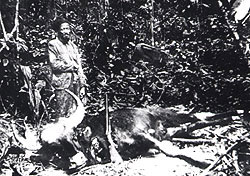
Another unfortunate beast taken for a few dollars. courtesy of Arkib Negara Malaysia |
On our way to the Jenderak Breeding centre, we stopped by for coffee at a local 'café' where we met a Chinese gentleman who was relating a story about a large 'kenduri' or banquet prepared to celebrate a happy occasion at a village nearby. The village men had gone into the jungle to pick up a few 'pounds of meat' for the banquet and along the way; they came across a lone bull (seladang). With no hesitation, they shot the bull, cut him up into pieces and carried it back for the celebration. According to the gentleman, such activities are still rampant but how accurate is the report, we cannot determine. Perhaps heresy, perhaps not.
The most exciting part about taking time off to travel without tight schedules is that one can always travel off the beaten tracks and explore the beauty of lesser-known places without hesitation. Jenderak Seladang Sanctuary is not easy to get to without a car. Ample time is required. One has to make a trip to Pahang, taking the old roads that were once laden with cars, lorries and bullock carts that has now diverted to the larger trunk roads and highways. Traffic on these roads these days has trickled to a few trucks and the odd car or so. (Bullock carts are now virtually a thing of the past). But these roads are still a delight to travel on if you're not rushing to get somewhere.
Accommodation and Holiday Packages to Jenderak Seladang Sanctuary
The closest and most convenient place to stay is at Jerantut
Malaysia Rainforests, Sanctuaries and Parks
Short Adventure & Nature Trips
 Getting There and Away
 Best Time to Go
 Nature activities