 |
Who would have thought? A mere hour and a half from the bustle and flurry of the city lies a haven where human, animal and bird life all can find peace and tranquillity. Situated at the mouth of the Selangor River lies the Kuala Selangor Nature Park, haven of resident and migratory birds (from as far as Siberia and Northern China) and a host of other amazing wildlife.
Kuala Selangor Nature Park is a unique slice of landscape made up of 497 acres (201 hectares) of secondary forest; formerly a mangrove forest. After the land was reclaimed along the coast, the mangrove forest was unable to sustain itself. Thus the secondary forest is now mainly dominated by strangling figs and other coastal trees like the Cordia dichtama; along with the mangrove fern. Mangroves however still cover about 234 acres (95 hectares) of the park. These trees have been allowed to rejuvenate within the boundaries of the park.
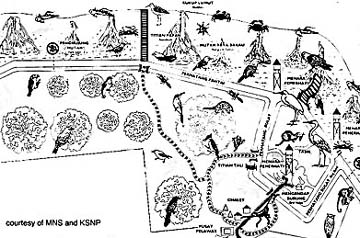
There are four clearly marked trails varying from 30 minutes to 80 minutes - maps of which are available at the entry point.
One of the trails has the flora marked with explanation.
Trail |
Distance |
Return Time |
Egret 80min |
550m |
30min |
Macaque |
436m |
25min |
Eagle |
988m |
50min |
Langur |
1100m |
80min |
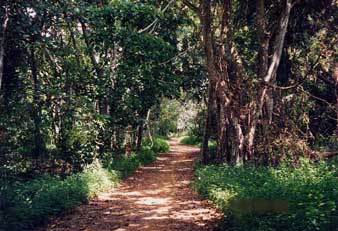 |
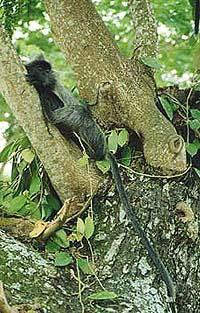
However, unless one is a seasoned walker, a guide familiar with the flora and fauna of the area is required. For the untrained ear and eye, the subtle nuances, which the nature park is infused with requires interpretation. We were fortunate enough to meet with an experienced guide who invited us to join his small group. Immediately, the park took on a new dimension. Both land and sky were brimming with life. We chanced upon several monitor lizards ambling lazily along, a pretty white breasted king-fisher, a flock of herons taking rest, beautiful silver leaf monkeys peering curiously from their tree perches, cheeky long tailed macaques scurrying from tree to tree, storks, egrets and mudskippers. The several brahminy kites soaring above made us acutely aware of the expanse and breadth of the park. Unfortunately, the afternoon sun was too hot for the frolicking otters but there certainly were a lot of droppings along the path to remind us of their presence.
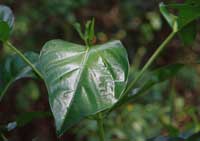 |
Our 'adopted' guide also pointed out to us an abundance of a local plant called mengkudu (noni) believed to have a range of healing properties. Its young shoots when heated over fire, applied to cuts and then bandaged is said to speed up the healing process. Its fruit when juiced is believed to have cancer-curing properties.
Exploring the young mangrove forest known to comprise of 13 species is another highlight not to be missed. To make access into the mangroves easier, two wooden boardwalks have been constructed although one has been closed for a while now for safety reasons. One boardwalk stops in the middle of the mangrove forest (under repair at the time of visit) and the other leads right to the mudflats into the Straits of Malacca.
 |
This walk through the mangroves provides an interesting contrast to the greenery of the secondary forest. During low tide one can have the luxury of observing the teeming animal life in the soft mud. Here one can take in a scenic view of the fine Avecennia forest and also observe the cockle and fishing boats in the near distance. A note of caution: be well prepared for the mosquitoes. Wearing a light cotton long-sleeved top and long pants is highly advisable. Arm yourself with insect repellent and try to avoid keeping still for prolonged periods.
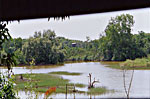
In the centre of the park, a man-made bird wading lake stands picturesquely; the brackish water is taken from the estuary of the Selangor River. The lake provides a roosting and feeding site for the many bird species. Here, at the height of the migratory bird season, normally around September - a large variety of birds find their way to this haven. Seeking respite from the winter months the birds come from as far away as northern China and Siberia. As many as 100,000 wading birds of 30-odd species have been recorded to converge here at the height of the season. The season lasts until April of the following year.
 |
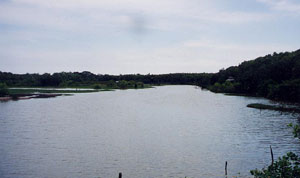
At least 156 resident and migratory species have been sighted over the years. They include shrikes, kingfishers, pond herons, bee-eaters, water cocks and a variety of waders. The rare Norman Greenshank and Mangrove Pitta have also been spotted here. Avid bird watchers (as well as amateurs alike) should find quite an oasis here. Situated around the lake system are a number of little huts/hides and towers where one can observe the different bird species - especially water birds and waders. Park officers advise that the best time for bird watching would be during the early morning or the late evening, when the weather is cooler.
 |
Chalets are available for hire for those wanting to spend more time at the park especially for early risers wanting to catch the early bird! The chalets have tap water and electricity, and much needed (!) mosquito nets as well as fans. Bedding is provided and all one needs to come prepared with are personal belongings, toiletries and bath towels.
All in all, the Kuala Selangor Nature Park holds the promise of discoveries of all sorts. The dominance of ferns and creepers, in the different lights of daytime and evening time, gives one quite a surreal feel - almost like an enchanted forest. There is a sense of peace and stillness one draws from being there. The beauty of the ferny, green secondary forest contrasts against the textured browns of the mangroves, together with the calmness of the lake standing pretty in the midst of park leaves one with a feeling of deep appreciation of Nature's abundance.
It is definitely worth a visit.
article written by Cynthia Lim. 2002
Bird watching
Birdwatchers would find it a great time to go during the migratory period from August till April
What to look out for:
Beware of the long tailed macaques usually found loitering around the entrance to the park. They can get a little too boisterous and if you're with food, they may approach for some. The park rangers strongly discourage visitors from feeding them…smart as the monkeys are, the next time they see a visitor-they would expect to be fed and if they do not receive the same response, they may turn on unsuspecting trekkers.
A large aviary housing the endangered milky storks. A breeding programme is conducted in the aviary to help boost the dwindling population of these birds
Extra Info A birdlist of some of the birds found at KSNP. - both migratory and resident:
- Little Egret, Intermediate Egret, Grey Heron, Purple Heron, Great Heron, Great Egret, Chinese Pond Heron, Striated (Little) Heron, Yellow Bittern |
- Black Baza, Brahminy Kite, White-Bellied Sea Eagle, Crested Serpent Eagle, Japanese Sparrowhawk, Black-thighed Falconet |
- Red Junglefowl (especially at Trail D), White Breasted Waterhen, Watercock, Common Snipe, Marsh Sandpiper, Terek Sandpiper, Common Sandpiper, Common Greenshank, Curlew Sandpiper, Mongolian Plover, Rufous-necked Stint |
- Pink-Necked Pigeon, Zebra Dove, Cuckoo |
- Koel, Chested-Bellied Malkoha, Chestnut-Breasted Malkoha, Greater Coucal |
- Collared Scops-Owl, Large-Tailed Nightjar - Asian Palm Swift, Little Swift |
- Common Kingfisher, White-Throated Kingfisher, Black-Capped Kingfisher, Stork-Billed Kingfisher, Collared Kingfisher |
- Blue-Throated Bee-Eater, Blue-Tailed Bee-Eater |
- Sunda Woodpecker, Laced Woodpecker |
- Mangrove Whistler, Pied Fantail, Ashy Drongo |
- Common Iora, Black-Naped Oriole, Ashy Minivet |
- Common Myna, Jungla Myna, Hill Myna, Brown Shrike Asian Glossy Starling |
- Barn Swallow, Pacific Swallow, Red-Rumped Swallow - Mangrove Blue-Flycatcher, Magpie Robin |
- Yellow-Vented Bulbul, Olive Winged Bulbul |
- Oriental White-Eye, Yellow-Bellied Prinia |
- Common Tailorbird, Ashy Tailorbird |
- Arctic Warbler, Striped-Tit Warbler, Abbot's Babbler |
- Great Tit, White-Rump Munia, Scaly-Breasted Munia |
- Forest Wagtail, Plain-Throated Sunbird, Olive-Backed Sunbird,Ruby-Cheeked Sunbird, Little Spiderhunter |
more on kuala selangor town...
Accommodation and Packages to Kuala Lumpur , KLIA , Petaling Jaya, Damansara , Subang , Sunway, Putrajaya, Kuala Kubu Bahru , Kuala Selangor, Klang and Surroundings
Malaysia Rainforests, Sanctuaries and Parks
Short Adventure & Nature Trips
 Getting There and Away
 Best Time to Go