In recent years, Kuala Gandah Elephant Centre has become a very popular destination for tourists and especially so during Weekends and School/Public Holidays. There have been numerous complaints from our guests on the lack of crowd control at the centre and the lack of handicap friendly facilities available there. We would like to advise you to visit the centre on any other time other than Fridays, Saturdays & Sundays and school/public holidays to avoid disappointment. Please note : School & Public Holidays calendar here at ; Calendar 2011 Â . On Fridays, there is a long lunch break for friday prayers and the centre will only be open from 2.30pm onwards. |
Companyyyy march! Hup two, three, four..
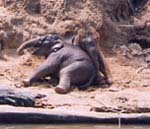 |

The little ones sneaking away from their keeper for a bit of fun at the sand pit |
Those of us who are familiar with 'Jungle Book'; Walt Disneys' animated movie adaptation of Rudyard Kipling's classic always remember 'Hathi', the leader of the elephant troop. Strong, demanding and not so much the stereotypical 'elephant that-never-forgets', Hathi is one of the more endearing characters. An old pompous bull, set in his ways, regimented, a retired member of the British battalion - ready to uphold chivalry and honour, and not forgetting that behind every great bull there is a great cow - Hathi epitomises the loveable nature of these gentle creatures. They are intelligent, individualistic, are highly disciplined and they adhere to the social rules and customs within the group. The adults are fiercely protective of their young and if threatened, they form a circle round their young to protect them from any impending danger, sacrificing themselves if need be. In reality, the leader of a herd of elephant is not a male but rather a dominant female (a cow) known as the 'Matriach'. The Matriach is normally the largest female in the herd and she leads her family group of between 15 to 30 individuals consisting mainly of female adults and their young and several young male elephants. We find that adult males generally live a solitary life. However, it is not uncommon to find them living in herds especially during mating seasons.
This leads to a long forgotten story of dedication and strong social bonding amongst elephants.There once was a large bull that lived in the jungles of Teluk Anson (Teluk Intan) with a large group of resident elephants. One day the herd went for a stroll to the edge of the jungle, close to the old Port Weld - Taiping railway line. This was not an exceptionally busy railway line and a slow locomotive ran the track only once daily, transporting goods and people to and from the port. Then one fateful day as the elephants ambled across the tracks as they probably had done a million times over for they are creatures of habit, they had failed to notice the goods train chugging down the tracks until the very last moment. In a desperate attempt to save the family, the bull rushed to the tracks and stood his ground, between the oncoming train and the herd.
|
courtesy of arkib negara malaysia. train derailed by elephant |
The train rammed right into the elephant and the impact toppled the train. He had saved the herd but alas! sacrificed his life in the process. The British were so touched by the story (one of many versions, I might add!) of the elephant's sacrifice that they erected a monument where he lay as a remembrance to her and her family. The forgotten plaque still stands by the side of the now abandoned track . Now, flyways and highways divert traffic away from old abandoned railway line. Vegetable plots line the land where the plaque stands - the only reminder of heroism beyond imagination.
The elephant's skull was transported to Kuala Lumpur and can now be seen at the National Museum (Muzium Negara). A little showcase of a great deed hidden in the archives of oblivion. The elephant's unconditional love for one another and social dedication to each member of the group is truly admirable; basic building blocks for healthy communal living for many to emulate.
Ancestors of the elephant
|
The Asian elephant (elephas maximus) is found throughout tropical rainforests stretching from Indochina which includes Vietnam and Cambodia, into Burma(now called Myanmar) down Thailand trickling into Malaysia and Indonesia. These gigantic animals can be traced through a lineage dating as far back as 45 to 55million years ago during the Eocene Period. Archaeological evidences indicates that the early ancestors of these giants were in fact, tiny 1 metre tall creatures with no resemblance to the modern elephants we see today. They didn't even have a trunk to start with! But through millions of years of evolution, some 150 different species were produced; some dying off and others evolving into more resilient species. In our modern world, only 2 species are found namely the African elephant and the Asian or Indian elephant. Today the closest relative of the elephant is the manatee and dugong and the closest land relative is the hyrax.
The working elephants
|
In the early days of trade, elephants were used widely as a form of transportation and a number were trained for the use in royal households especially for royal processions to pull the royal coaches. During the reign of the Melaka sultanate in the early 15th century right through to the Portuguese rule of Melaka, trained elephants were often supplied to the royal families in India and many merchants prospered through this little known trade. Elephants and their mahouts were loaded onto ships sailing for months in the open seas to the shores of India. In the later years, other forms of transportation replaced the use of elephants in Malaysia, elephants were no longer required and were left to roam the jungles. Therefore in modern day Malaysia, unlike in Thailand and Myanmar, trained elephants are nonexistent. The remaining Asian elephant population in Malaysia are wild. Hence, at the Kuala Gandah Elephant centre, the trained adult elephants are imported from Myanmar and a few are scheduled to arrive from the Thailand to assist the rangers in their translocation programme of wild elephants.
At the centre
|
We'd heard about the elephant centre from a few expatriate friends a couple of years ago. Thinking it was a long way from KL, we never got round to visiting the place. So it came as a pleasant surprise that the drive took only an hour from the gombak toll to the centre . And it was a day well spent indeed! We arrived at the sanctuary at 1.45pm. One of the keepers we met at the entrance informed us that a video presentation was scheduled for 2.00pm and that the tour round the grounds would be conducted after the show. At 2.00pm sharp(!!), we were shown into a little audio-visual theatre that reminded us of those familiar little lecture rooms. Chairs with small removable tables attached to one arm, cluttered the room. As the air-conditioning cooled our heated brow, the lights were dimmed and we settled in for a 25min presentation of 'The plight of the homeless elephant'.
This video presentation gave us a better understanding of the work conducted at the centre, the duty of the elephants and the highly dangerous job of the rangers when they're out in the field conducting wild elephants translocation projects. Male elephants have a territorial homerange of about 400+ km² and females of about 300+ km². Contrary to what we think of the tropical rainforest as rich and with abundance of food for the wildlife, it is in fact the opposite. Full-grown elephants eat as much as 225kg of food everyday and sometimes they have to travel far just to find enough to satisfy their hunger. When they have such a wide home range (and they can cover a lot of ground in a day), the elephants are bound to come into contact with humans. Then comes the human-elephant conflict.
|
As more of the jungle or forested areas are being converted into plantations and human settlements, the poor elephants are being squeezed out of their ancestral homes. Moreover, the elephants' keen sense of smell sometimes lead them into trouble. Elephants cannot resist the delicious roots of young palm trees. They sneak out into plantations at night to raid the nurseries; uprooting every tree in sight. There are other times when the wild elephants are entrapped in the middle of approaching development. In such situations, these frightened beasts have known to bulldoze acres of freshly planted crops. In many cases, the plantation owners - tired of having to foot the bill for the damage, calls the team to remove the elephants. As elephants are strictly protected under the Protection of Wildlife Act of 1972 under the endangered species listing, culling of elephants are prohibited. The rangers move in on the area, track them down, capture and translocate the elephants to other areas or larger tracts of jungle/forested areas so that they may roam in peace.
more on research done on the wild elephants in Malaysia, log onto:
ABORIGINE SETTLEMENT & ELEPHANT SANCTUARY
‘An adventurous outing’
The journey takes approximately 1 hour 45 minutes. Our first stop is the Aborigine Settlement.
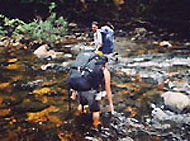
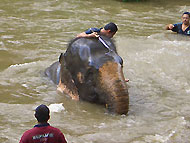
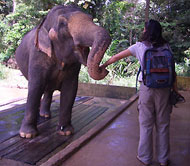
Kuala Gandah Elephant conservation was established in 1989 by the Department of Wildlife and National Parks. The center is a base for the Elephant Relocation Team, which began the elephant translocation programme in 1974. The only one of its kind in Malaysia, the team is dedicated to locating, subduing and then translocating problem elephants from areas where their habitats are constantly being encroached by plantations and to other suitable habitats throughout the Peninsular such as Taman Negara. Over the past 25 yrs the centre has helped prevent the further declined of the elephant population by relocating more than 300 wild elephants. Tour includes elephant ride, elephant feeding and for those who are brave, we suggest you bring a change of clothes and towel if you wish to participate in water activities such as swimming and bathing the elephants in the river
• Minimum 2 adults
• Please wear comfortable walking shoes, cap / hat and bring along bath towel and spare clothing in case you get wet or dirty
• Inclusive of lunch
Departure : Daily at 9.30 am
Pick up : 8.45 – 9.15 am
Duration : 8 hrs
**Please Note that there will be a non-refundable handling charge on payment made. Conditions apply.
 |

|
Accommodation and Packages to Pahang ~ Janda Baik, Cameron Highlands, Taman Negara, Kenong Rimba Reserve, Fraser's Hill, Cherating, Pulau Tioman, Kuantan, Tasik Bera and Surroundings
Malaysia Rainforests, Sanctuaries and Parks
Short Adventure & Nature Trips
 Getting There and Away
 Best Time to Go
 Nature activities
 Kuala Gandah and surroundings accommodation & packages ...