| Trip Rates | Course Overview | Basic Skills | Trip Description | map: location...
 |
|
 |
 |
 |
 |
 |
|
|
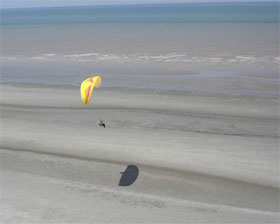
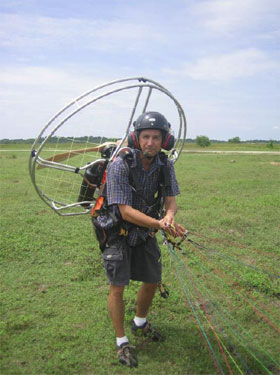
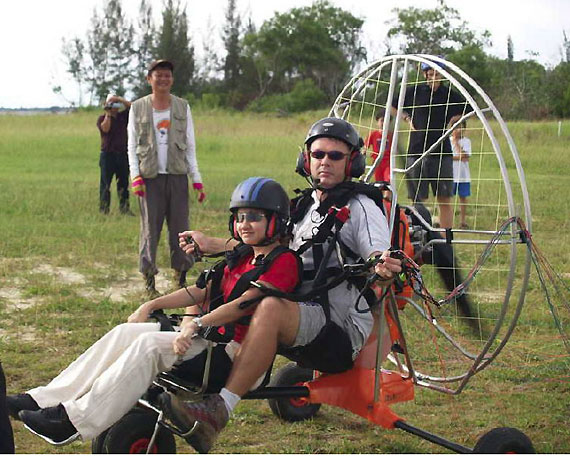
Motorized Paragliding is simply good fun. If ever you have had dreams of flight where you run, flap the arms and take off⦠well, this is about as close to those dreams as you can get! ⢠Flying a motorized paraglider is easy, rewarding and, with the proper training and equipment, very safe. ⢠Motorized paragliding offers flying like no other type of aircraft in that it is possible to fly high and far or low and slow. ⢠Motorized paragliding is undoubtedly the least expensive form of powered flight. The equipment is most certainly less expensive than most other powered aircraft and a day in the sky will only cost a few dollars in fuel bills. ⢠Motorized paragliders are portable and easily transported to any location providing an infinite variety of flying locations. With careful pre-trip preparation and packing, motorized paragliders can often be checked in on commercial flights thereby increasing the range of flying opportunities to almost anywhere on the planet. ⢠For many it is the challenge of flying an aircraft as pilot in command. For others it is the challenge of learning to fly an aircraft which requires a higher level of environmental awareness and physical skills than flying normal fixed wing aircraft. ⢠Paragliding also offers one of the best platforms for aerial photography because of the virtually unrestricted field of view from the harness in addition to the ability to fly in low and slow to capture excellent stills or video. ⢠Other exciting aspects of motorized paragliding include competitions, cross country flights and social flying events! |
(Rate based on per person basis)
Course Type |
Rates per person (RM) |
Single student fee |
RM 3,500 nett |
Multiple student fee or if joining other students |
RM 3,000 nett |
Course Include:
* Safety briefing * Flying theory and training overview * Ground handling skills * Introduction to engine and equipment * Chute pulling techniques for takeoff * Flying skills * Landing skills * Power management on takeoff skills * Demonstration flights * Radio instructed solo flights
Student Requirements:
* MPG Training course duration: 15 - 20 hours or up to first two solo flights (whichever comes first)
; (Additional training at RM 150/hour) ; Usually completed within 4-5 days (over several weekends if necessary)
* All equipment provided
* No previous flying experience required * Takes place usually on weekends from 2-7pm though weekdays are possible* First solo flights take place at Pulau Indah (near Westport, Klang)
**Please Note that there will be a non-refundable handling charge on payment made. Conditions apply.
 |

|
|
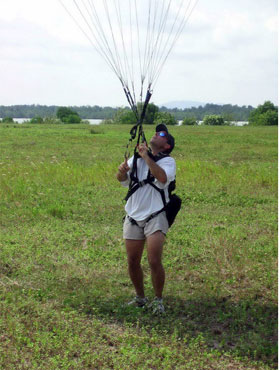
Normally training requires at least three to five days depending on weather conditions and individual ability. Training begins at an open field where ground handling skills are taught. Final flights take place at an open area away from buildings and obstacles. Final flight will be with radio instruction for directing the student on flight technique. The initial training involves learning how to control the wing on takeoff and landing and use of the harness and motor whilst in flight. A lot of attention is paid to wind speed and direction, as this is critical for a successful inflation and take-off. After ground training and assessment by the instructors, students then complete the first solo flight with additional flight instructions provided from the ground via 2-way radios. Students are advised to have the objective of achieving a Restricted Private Pilotâs License - PPL(R). What is the most challenging aspect of learning to fly? For the beginner, a significant part of the training is focused on take-off technique. The
reason for this is that learning to take-off in a motorized paraglider by far the most
complex task with an infinite number of variables that may affect the success of the
launch. Many students become masters of individual skills; though instantly forget
everything as soon as it comes time to coordinate everything and fly solo with the motor
for the first time. The âfear-factorâ is also significantly increased by having a propeller spinning in the air
behind the pilot together with the thought of taking a âleap of faithâ into the unfamiliar
environment of flight. Completing a good take-off launch is one of the most satisfying aspects of paramotoring. There is nothing like the pleasure of running forwards, feeling the tightening of the harness around the legs and being lifted into the sky! There isnât a paramotor pilot on the planet who will not say this is truly an amazing feeling and experience! There are several, easy to learn basic skills that are that must be automatic responses before the first take-off is attempted. These simple techniques and concepts can make the difference between a successful and gratifying experience, or sitting on your butt with a broken propeller or a âpara-blendedâ wing; both being common consequences of poor take-off technique! |
 Destination Selangor ~ Klang ~ Pulau Indah adventure description Training begins at an open field where ground handling skills are taught. Final flights take
place at an open area away from buildings and obstacles. Final flight will be with radio
instruction for directing the student on flight technique.
The initial training involves learning how to control the wing on takeoff and landing and
use of the harness and motor whilst in flight. A lot of attention is paid to wind speed and
direction, as this is critical for a successful inflation and take-off Trip Duration and Equipment course duration
~ 15 - 20 hours or up to first two solo flights (whichever comes first)
; (Additional training at RM 150/hour) ;
Usually completed within 4-5 days (over several weekends if necessary) What To Bring drinking water and other refreshments for training sessions. A small towel is also
useful. There are shops near the training site, however What To Wear Initial field training sessions can be quite warm as some physical activity is required.
Dress cool, comfortable and casual with shorts, t-shirt and a hat.
For footwear, flat-soled trainers are OK though no sandals or slippers. Hiking or trainer
boots are highly recommended as these provide more ankle support and grip. Donât
forget the sun block
Destination Selangor ~ Klang ~ Pulau Indah adventure description Training begins at an open field where ground handling skills are taught. Final flights take
place at an open area away from buildings and obstacles. Final flight will be with radio
instruction for directing the student on flight technique.
The initial training involves learning how to control the wing on takeoff and landing and
use of the harness and motor whilst in flight. A lot of attention is paid to wind speed and
direction, as this is critical for a successful inflation and take-off Trip Duration and Equipment course duration
~ 15 - 20 hours or up to first two solo flights (whichever comes first)
; (Additional training at RM 150/hour) ;
Usually completed within 4-5 days (over several weekends if necessary) What To Bring drinking water and other refreshments for training sessions. A small towel is also
useful. There are shops near the training site, however What To Wear Initial field training sessions can be quite warm as some physical activity is required.
Dress cool, comfortable and casual with shorts, t-shirt and a hat.
For footwear, flat-soled trainers are OK though no sandals or slippers. Hiking or trainer
boots are highly recommended as these provide more ankle support and grip. Donât
forget the sun block
Accommodation and Packages to Kuala Lumpur , KLIA , Petaling Jaya, Damansara , Subang , Sunway, Putrajaya, Kuala Kubu Bahru , Kuala Selangor, Klang and Surroundings
Malaysia Cities , Towns & Villages
Peninsula Malaysia Cities , Towns & Villages |
|
Kedah |
| Alor Setar | |
Terengganu |
| Chukai | Dungun | Kemaman | Kijal | Kuala Terengganu | Paka | |
Perak |
| Ipoh | Kuala Kangsar | Lumut | Taiping | |
Selangor |
| Klang | Kuala Selangor | |
Kelantan |
| Kota Bahru | |
Federal Territory |
| Kuala Lumpur | |
Johor |
| Mersing | |
Negri Sembilan |
| Seremban | Kuala Pilah | Lukut | |
Pahang |
| Sungei Lembing | Kuala Lipis | |
Melaka |
| Melaka | |
Sabah and Sarawak Towns , Cities & Villages |
|
Sarawak |
| Kuching | Long Bedian | Long Lama | Long Terawan | Miri | Marudi | |
Sabah |
| Sandakan | Kota Kinabalu | Tawau | |
 Getting There and Away
 Best Time to Go
 Food in the city
  Art & Entertainment
 Shopping
 Nightlife