Iban Longhouse
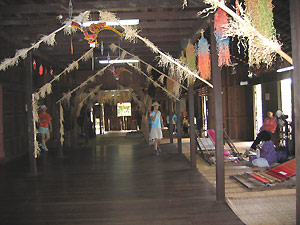
women weaving the pua at the Iban longhouse |
The Iban longhouse sits on stilts and normally accommodates the entire village. Unlike the land dayaks, the Ibans or Sea Dayaks position their villages on the banks of accessible waterways. The Ibans are great adventurers and take long sojourns across lands but prefer using the waterways to move about.
The longhouse is inhabited seldom more than 15 or 20years. There are various reasons as to why an Iban community would move. The new site would quite often be in the same tributary or in the same river, within a few miles from the old one perhaps because the good timber and planks are removed from the old longhouse and towed along the river to the new site. As Ibans practice shift cultivation, moving often results from looking for fertile land to till after the existing land has been exhausted. The same area is normally cultivated not more than 4 times at intervals of several years. Other reasons would be from enemy attacks sometimes causing burning of the longhouse, or an epidemic that hit the village or if the villagers have been hit with a string of bad luck or evil omens.
The Ibans conduct certain rituals upon opening new padifields etc. Life-sized images of a crocodile is molded in clay by an elder and placed on the land chosen for farming. This crocodile is believed to destroy all pests that eat the rice. Many Ibans as in other tribes claim to be closely related to certain animals in the jungle. For the Ibans it is the crocodile. Also it is believed that the Ribai, the River god sometimes appear as a crocodile but he may appear as a bear or a tiger, or the python or the mias (orangutan). Therefore the Ibans seldom kill these animals for fear that should he kill one which was really the Ribai, which in turn would cause him the ultimate fear of insanity.
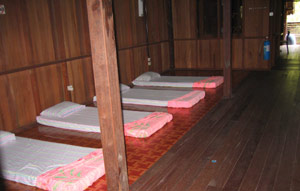
visitors can opt to stay at the iban longhouse at sarawak culutral village |
Living along rivers, each Iban family possesses at least one boat, big enough to fit 8persons and used mainly to transport to and from the padifields and for short trips. The village itself would have several larger boats used for long journeys and at least one war boat capable of carrying 50-100 men. 'Each boat, even one of the largest size, is hollowed from a single log, the freeboard being raised by lashing narrow planks to the edge of the hollowed log. In the middle of a large boat is a section, the freeboard of which is raised still higher, and which is covered by an arched roof of palm leaves. The boat is crossed at intervals of some three feet by seats. In traveling on the lower reaches of the rivers, the rowers sit two on each bench,side by side and facing the bow. On the upper reaches, where rapids abound, a deck is made by laying split bamboos along the length of the boat upon the benches, and the crew sits upon this deck in paddling, or stands upon it when poling the boat over rapids.' Charles Hose, Pagan Tribes of Borneo . If a boat is urgently required and none at hand is available, Ibans construct makeshift boats by stripping the bark from a big tree. This boat can be completed within 2 hours and are able to carry several men and baggage. Rattan strips are used to tie together the ends of the sheet of bark to make a bow and stern. The body of the boat is strengthened with ribs and longitudinal strips; and crossed pieces of wood are wedged in the middle to form seats. Apart from these material possessions, the Ibans and most other tribes prized their jars.. The more common jars stand about 3 ft in height and are brown with glazed finishing. The jars are commonly moulded in relief with Chinese dragon (BENAGA), or some animal designs by name of RUSA (=deer) and NINGKA. Ibans are willing to pay from 200 to 400 dollars each. The older the jars, the higher the value. These valued jars were originally imported from China but later were produced by the Chinese in Borneo .
Spending weeks away from their village out on hunts or headhunting trips, the Ibans brought along with them a homemade lighter. The cylinder is made from lead or brass, which is cast by pouring the molten metal into a bamboo casing. An iron rod is held in the middle of the bamboo mould to form a bore. The lighter is some 5 inches long. Once the molten metal is cooled, the iron rod is removed. A wooden piston is shaped to fit snugly into the bore when driven down the cylinder. The piston is pushed down with a force and quickly withdrawn. The action produces heat through compression of the trapped air, which in turn ignites a bit of tinder at the bottom of the cylinder. The tinder is made of the fibrous surface of the leaf stem of the Arenga Palm.
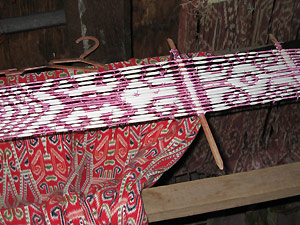 |
Another, handicraft worth mentioning and unique to the Ibans is Pua Weaving. The weaving is done usually by women although the men have a hand in constructing the machines. The kain or pua is made of cotton which is collected from shrubs cultivated by the women in their gardens. The raw cotton is processed by removing the seeds and fibre by hand. The threads are then spun from the tangle of fibre using a simple wheel. The cloths are normally of 2 colours plus the natural colour of the thread. The warm brick red that is commonly seen in pua designs are made from the bark of the Samak tree and the dark purple are obtained from the leaves of the Tarum plant. A long thread is wound longitudinally on a wooden frame about 6 ft long and 20in wide. A pattern is set by tying the upper and lower set of threads in bundles with dried strips of a fibrous leaf called Lemba. The making of a pua is a long process. When there are 2 colours, those patterns that are to be of one colour, eg red are wrapped with the strips of lemba to resist the purple dye when the web is immersed in a tub to be coloured purple. The designs that are to be left a natural colour are also wrapped. The immersion is to take 3 days and after, the web is hung in the shade to dry. When this first dying is completed, the undyed parts are uncovered to absorb the red dye and the bundles of threads that have already been dyed purple are wrapped again to resist the red dye upon immersion. The Lemba fibres are waterproof and resist dyes effectively. Charles Hose marveled that the women would wrap up the threads to set the patterns without any guide, working on the designs purely on memory. Sometimes the weaver creates a design based on a dream she had. Designs are passed on from weaver to daughter for generations. For more on the process of weaving, click to pua kumbu.
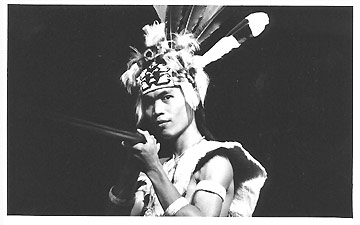 |
The Ibans men dress flamboyantly as compared with tribes living in the interior, who dress in little but chawats or bark cloth. He enjoys adorning brightly coloured cloth about the waist, turbans with feathers and other ornaments. The Iban woman wears a short skirt from the waist to the knee and a long-sleeved jacket both woven cotton material. She also wears a corset made from a stack of rattan rings to enclose her body from breast to waist. Each rattan ring is sheathed in small rings of beaten brass. The corset is made to open partially or completely down the front, but is often worn continuously for long periods and is removed when pregnant.
For those wanting to stay at the Iban longhouse in the Sarawak Cultural Centre, it's possible to rent a bed in the dorm. Contact for more information.
Accommodation and Packages to Kuching, Damai Beach, Bako National Park and Batang Ai National Park
Malaysia Cultural Activities, Festivals and Arts, People
Festivals |
| Thaipusam (Hindu) | Keng Chek Festival (Taoist) | Hungry Ghost Festival(Taoist) | Moon Cake Festival (Chinese) | Ari Muyang Hma' Meri (Orang Asli) | |
Cloth Weaving |
| Songket Weaving | Pua Kumbu | Dastar of Sabah | Kain Tenun Pahang | |
Street Markets/Art |
|
Cultural Villages/Centres |
| Sarawak Cultural Village | Monsopiad Cultural Village - Sabah | Kampung Sumangkap (Gong making village) - Sabah | Kampung Gombizau (Honey Bee farm) - Sabah | |
Traditional Sarawak houses |
| Bidayuh longhouse | Iban longhouse | Penan huts | Orang Ulu longhouse | Melanau tallhouse | |
Sabah Peoples/Traditions |
| The Rungus | |
 Getting There and Away
 Best Time to Go